Wednesday, November 23, 2011

The Twelve Books of Christmas

Well, apparently it's book month.  I didn't plan it that way, but after weeks of illness, perhaps gushing over my favorite books requires the least amount of energy and provides the most therapeutic joy.  Oh, and I also wanted to get some book ideas out there prior to advent and the start the Christmas gift buying season.


~~~~~~~~~~


A highlight of our advent season is the unpacking of our box of beautiful Christmas books.  They, like our favorite ornaments, embody the ghosts of Christmases past.  Each holds a dear memory - curling up by the fire with hot chocolate in hand, the twinkle of Christmas tree lights dappling the ceiling, babes in footed fleece pjs cuddling on mommy, or the "remember whens" represented by many of the vacation-purchased ornaments.  Out of that box of books, we unpack love, anticipation, excitement and tradition, and every year, we look forward to carefully choosing and adding a new addition or two.  


A few years ago, we began a new Christmas tradition.  The kiddos open their sleepy eyes Christmas morning to find a small stack of books sitting at the foot of their beds.  The day starts peacefully, as they enjoy exploring the newest additions to their libraries.  Mom and Dad also happen to benefit from a little more sleep before the present-opening festivities begin.  We do love our books!


Here are a few of our favorite Christmas books, and two new ones we'll be adding to the family:


12.  We're looking forward to receiving a copy of Russ Ramsey's new book Behold the Lamb of God.  For those of you who are familiar with Andrew Peterson's Behold the Lamb of God Christmas concerts, this is written with the same heartbeat.
"When Andrew Peterson sings 'Behold the Lamb,' three worlds collide:  ours, Abraham's and Jesus'.  Russ Ramsey's book opens the doors between those worlds and helps us bring them together."  Michael Card
Behold the Lamb of God can be used either for personal reflection or as a family devotional during advent.  The jury is out regarding the book's inaugural use in our home (I may selfishly monopolize this first year),  but I look forward to incorporating it into our annual Christmas reading list.


If you would like to download a free preview of Behold the Lamb of God or place an order, you can visit here.  There is also an option to bundle the book along with the CD, which makes a great Christmas present for those who are unfamiliar with Andrew Peterson's music.  You really can't go wrong with an amazing songwriter (Peterson) and a fellow-appreciator of Rembrandt (Ramsey).  

11.  If you have young ones in your life, you won't want to miss Sally Lloyd-Jones' new picture book Song of the Stars.  Our copy is in the mail, so I can't yet testify as to its beauty and warmth; however, I have the fullest confidence that I will soon be able to do so.  
"The Psalms tell us that the created order now declares the glory of God (Psalm 19 and 65) and then when Jesus returns even the trees will sing for Joy (Psalm 96).  How fitting, then, to imagine the animals and stars sensing and rejoicing in the coming of Christ for the first time.  This is a lovely book!"  Tim Keller


Perfect for young ones, or those who are young at heart.  You can purchase Song of the Stars here.


10.  A few years ago, a dear friend loaned a copy of Jotham's Journey to us for use during advent, and I was not prepared for the significant impact that reading it would have on our family.  Jotham's Journey is the first of a trilogy in which Arnold Yuletide weaves together the story of a young boy, his friends and their adventures leading up to the birth of Christ.  In reading these books, we're able to pull away from the hectic pace and distraction of our society in order to stop and consider the world into which Jesus was born.  A world ruled by the Roman Empire, a world of oppression, a world of political domination, a world of slavery... a world in need of a Savior.  Far from the typical peaceful manger scenes found in many children's books, Jotham's Journey  is rich in suspense, danger, anticipation, and confusion around the events that take place.


Each of the three books ( Jotham's Journey, Tabitha's Travels and Bartholomew's Passage) represents the viewpoint of one of the three friends, and the books don't necessarily need to be read in a particular order.  We read one each year, and I'm amazed by the corroborating details that the children remember from prior years.  Each chapter is to be read on a given day during advent and has a short devotional at it's end.  Given the intense nature of the political and social climate, I wouldn't recommend that they be read to children younger than elementary age.  There is enough substance and depth that these books would easily be enjoyed and appreciated by those without children in the home.  


You can order Jotham's Journey or its sibling books here.


9. The Birds' Christmas Carol is a heart-warming story about a little girl, who although sick and bedridden, embodies gratefulness and unselfishness as she plans a Christmas celebration for a needy neighboring family.  Written and published in 1887, this book whisks the reader back to the Victorian era, yet the love, compassion, and humorous family dynamics shared are timeless.


*You can download The Birds' Christmas Carol for free at gutenberg.org


8.  The Christmas Stories of George MacDonald.  How can you go wrong...


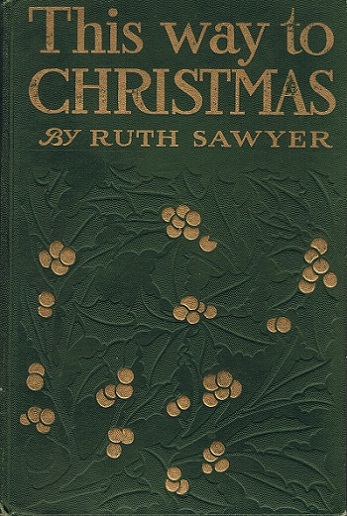
7.  We recently discovered This Way to Christmas by Ruth Sawyer.  In this delightful folktale, a young boy is sent away to live on a lonely mountain during the war.  As he gradually befriends his neighbors, he hears their tales of Christmas celebrations from other cultures.  I'd recommend that this book be read aloud, as there are a few sections which deal with prejudice, and some of the terminology merits discussing (or avoiding if you're reading with young children).  As one would expect, all ends well as the diverse, superstitious, isolated neighbors discover and enjoy community.


6.  Plum Pudding for Christmas by Virginia Kahl is pure fun.  True to her other books, it is written in rhyme, and is delightfully witty.  The king is away, and all chaos breaks loose when one of his many daughters eats the last plum in the kingdom.  How will a fitting Christmas celebration be possible?  Although out of print, it's fairly easy to find on Amazon, ebay, or addall.com.


5.  Christmas Day in the Morning by Pearl Buck is probably the least-known yet has become one of my most-loved books among the list.  This simple picture book depicts an unspoken, yet deeply felt love between a father and a son. The young boy makes a selfless choice in order to show his father the depth of his appreciation, and they are both blessed deeply as a result.  Life is found when one lays down his own comfort on behalf of another.  I cry every time I read it out loud.  


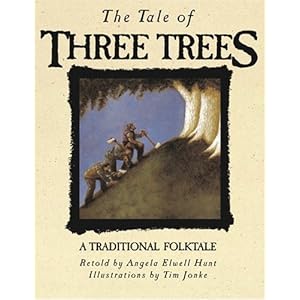
4.  A Tale of Three Trees reminds us that God's plan often differs from our own expectations and dreams - yet it is always best.  A beautifully-illustrated book that can (and should) be read during both the Christmas and Easter seasons.

3.  The Jesse Tree by Geraldine McCaughrean is ideal for children of elementary age through adults, and can be used as a family or personal devotional during advent.  As an old man whittles away at creating a Jesse Tree for his church, each symbol carved introduces a story from the lineage of Jesus.  We are reminded that all of history, beginning in the Garden of Eden, was in preparation for the One who would come to save us.  


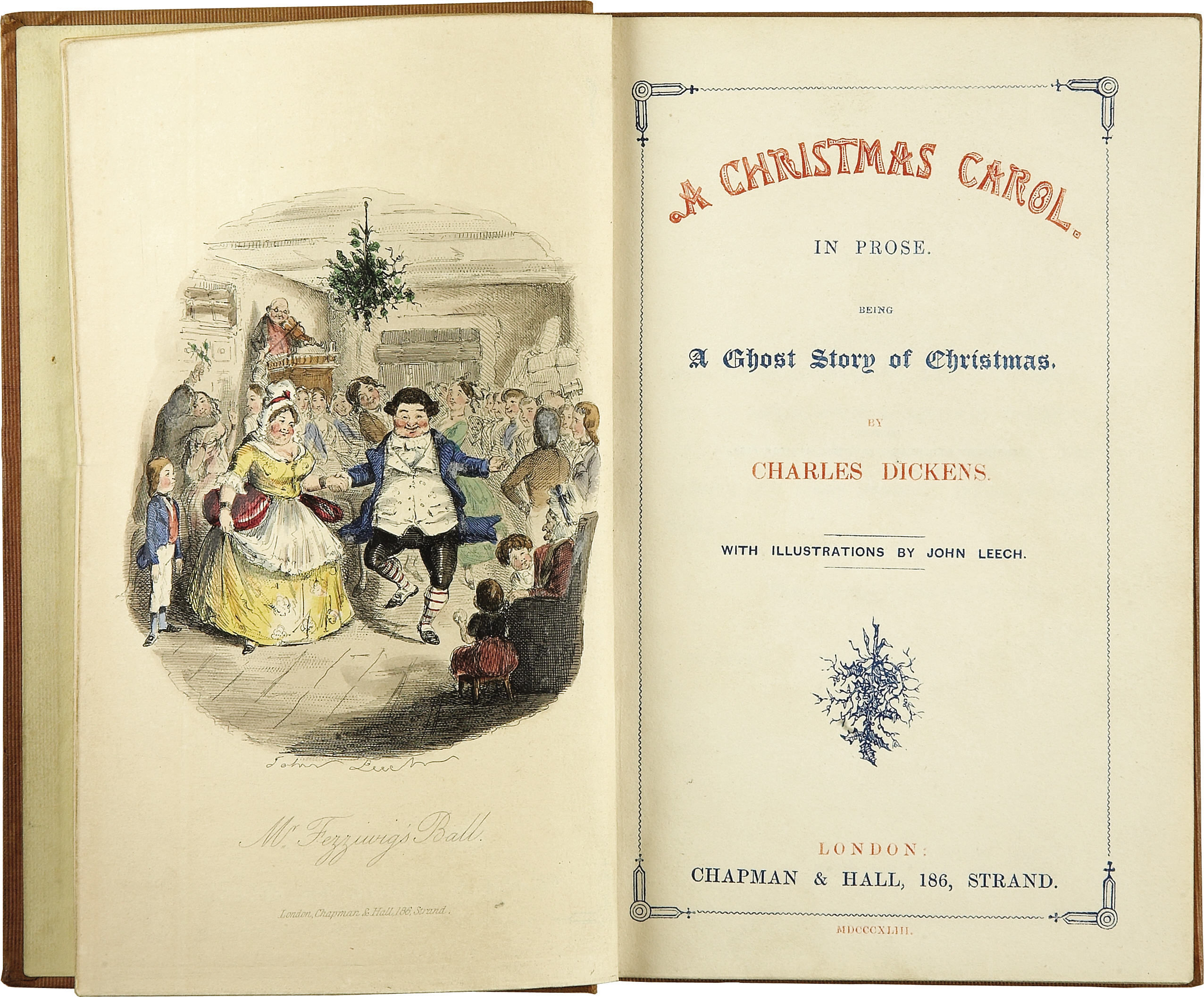
2.  A Christmas Carol by Charles Dickens.  It just gets better through the years.


*You can download A Christmas Carol for free at gutenberg.org

1.  The Year of the Perfect Christmas Tree by Gloria Houston will forever be one of our "staple" Christmas books.  It's simple, sweet story about an Appalachian family which is preparing for Christmas while at the same time longing for the father, who has yet to return from the war.  It's a story of hope, family, faith, perseverance, and Christmas miracles.


Wow.  That was harder than I thought it would be.  I feel compelled to console the books that didn't make the list by assuring them they'll be included next year.  Hmmm.  

If you're a lover of books, I hope that you've found something new to add to your collection.  If you're not, I'd invite you to discover a new treasure to add to your Christmas memories.

~~~~~~~~~~

During a season that is marked by food prepared to delight the palate, decorations hung to please the eye, and music played to bring joy the ear, it seems fitting that we carefully choose and read books which will nurture the soul.

Saturday, November 19, 2011

The Foundational Five: Poetry

"Genuine poetry can communicate before it can be understood."
T.S. Eliot 
~~~~~~~~~~

As I was pulling out my favorite books and resources on poetry, I was convicted.  I’m an idealist.  The world of beauty, goodness, well-chosen words and pursuit of truth is the world in which I aspire to invite my children.  I love poetry.  I’m thrilled that my children share some semblance of that same sentiment.  But as with so many other lofty aspirations, I’ve allowed the “necessary” to crowd out the routine enjoyment of our sharing poetry together. 

In writing this post, I've been reminded… of the wonder of childhood… of the joy found in falling in love with words… of the magic of language.

In the spirit of repentance,  I dutifully dug through a shelf crowded with binders, loose papers and workbooks to extract our book used for poetry memorization (more on that later).  My children’s responses to the sight of the book were delightful.  They clamored to recite long-forgotten verses.  They wanted more.

Why poetry?

“Poetry is the liveliest use of language, and nobody knows more instinctively how to take delight in that playfulness than children.”    
Serious Play:  Reading Poetry with Children

Jack and Jill, Humpty Dumpty, and Sam I Am.  Although it may have been years (or decades) since we’ve intentionally invested our time in reading poetry, most of us can recall these childhood rhymes with little to no effort.  They’ve been stored deeply within our memories alongside Christmas carols and favorite birthday presents.  Memorizing them came at no cost – we loved the words, the rhythm, the beautiful illustrations, and the endless repetition which provided comfort in a sometimes-unpredictable world. 

Poetry invites us into a magical realm where individual words, each which alone have only their assigned meaning, can be arranged in such a way as to result in a thing of beauty… or mystery… or cleverness.  To discover and enjoy poetry with our children is to cultivate their love for language.

Poetry can provide a vibrant thread to be woven into the unique fabric of our family culture.  When asked, “Who left the door open?”  I’ll often get the clever response ”Mr. Nobody.”  "Jonathan Blake" who ate too much cake can serve as a warning for all those consuming too many sweets. “I eat my peas with honey” (the opening to a clever poem taken from Benjamin West and His Cat Grimalkin) is recited when those particular veggies are served for dinner, and it wouldn’t be Christmas without A Visit from St. Nicholas

In addition to igniting our children’s love for language and enriching our family life, poetry provides the added benefit of contributing to their intellectual growth.
There is perhaps no greater tool than memorization to seal language patterns into a human brain, and there is perhaps nothing more effective than poetry to provide exactly what we want: reliably correct and sophisticated language patternsBy memorizing and reciting, you practically fuse neurons into permanent language storage patterns. Those patterns are then ready to be used, combined, adapted, and applied to express ideas in a myriad of ways. Additionally, because of the nature of poetry, poets are often compelled to stretch our vocabulary, utilizing words and expressions in uniquely sophisticated—but almost always correct—language patterns.”  Andrew Pudewa

We enjoy using A Word Well Spoken… Linguistic Development Through Poetry Memorization (found here) by Andrew Pudewa.  This thin spiral-bound book gives simple strategies for memorization and is divided into four sections, each with twenty poems.  The level of difficulty and length of the poems increase with each level, beginning with such fun poems as "Ooey Gooey Was a Worm" and ending with "The Hunting of the Dragon" by G.K. Chesterton.  Although children may occasionally memorize poems for school assignments, this approach allows a family to enjoy the process together.  A few minutes a day (perhaps right before dinner)  2-3 days a week is all the time required.  We have also found the companion CD helpful, particularly for young children to listen to during naptime or rides in the car. 

Some of our favorite books of poetry:

~Book of Nursery & Mother Goose Rhymes by Marguerite de Angeli
~Mother Goose by Kate Greenaway


~A Child's Garden of Verses by Robert Louis Stevenson (illustrated by Gyo Fujikawa or Tasha Tudor)


~The Complete Tales and Poems of Winnie-the-Pooh by A.A. Milne 
~Sing-Song: A Nursery Rhyme Book for Young Children by Christina Rosetti
~Animals, Animals by Eric Carle


~Hailstones and Halibut Bones by Mary O'Neill 
~The Beauty of the Beast by Jack Prelutsky
~The Complete Book of Nonsense by Edward Lear
~Poetry for Young People by Emily Dickinson (includes fun "riddle" poems of nature)
~Old Possum's Book of Practical Cats by T.S. Eliot (especially fun if you've shared the music from Cats with them)


Additional resources:
Jim Weiss audio Cds including Famously Funny - A Beloved Collection of Stories & Poems 
Blackstone Audio Cd collection Winnie-the-Pooh 
Dover Publications coloring book of A Child's Garden of Verses


~~~~~~~~~~
When we share the gift of poetry with our children, we are giving them an inheritance of deep love for language. It is a gift to be enjoyed while they are young, appreciated as they grow older, and passed on to future generations.
~~~~~~~~~~

*This is post one of what will eventually be five postings on foundational genres of literature for children.  More on the backdrop for those discussions can be found here.


Wednesday, November 9, 2011

First of the Foundational Five: The Bible

This is the first of what will eventually be five postings on foundational genres of literature for children.  More on the backdrop for those discussions here.


~~~~~~~~~~


During our children's early years, we have the great privilege of introducing the world to them, bit by bit.  As we begin exploring the literature that shapes the minds and souls of our young ones, we'll start at the very beginning... with the book that introduces the great themes found in all literature...  with the most published and widely read book of all time - the Bible.


There is an increasing acknowledgement, even in secular circles, that Biblical literacy is an important part of a well-rounded education. "The Bible's influence is impossible to ignore. There are more than a thousand Biblical references in the works of Shakespeare alone. John Milton, Herman Melville, Ernest Hemingway, all drew on the Bible, too.  Then there's Rembrandt, Chagall, da Vinci, who all put the Bible on canvas.  Even the Declaration of Independence alludes to the Bible." The Bible as Literature (CBS News). 


In addition to classical literature, Biblical references are plentiful in pop culture as well.   Leonard Cohen's ballad "Hallelujah," which has been performed by Justin Timberlake on an MTV telethon and K.D. Lang during the 2010 Olympics opening ceremonies, weaves together allusions to King David and Bathsheba as well as Samson and Delilah.   Virtually all aspects of our culture - sports, politics, movies, television, popular literature - are influenced to varying degrees by the Bible.


Well-written stories provide insight into the answers of life's fundamental questions such as "Who is God?" and "Who is man?" You can't get much more foundational than that.  Our views of the world, ourselves, and others are shaped by what we believe to be the answers to those questions.  The Bible answers virtually all of the "big" questions in life - even if the answer is to have faith in that which we do not fully understand.  


Currently, we live in a country where we have endless choices from which we can select children's Bibles.  A search for "children's Bibles" on Amazon.com, for example, yields over 31,000 results.  How do we begin to narrow down the plethora of choices? 


Here's a start:


For those who are young or old, those with no Bible knowledge or those who have seminary degrees, I highly recommend The Jesus Storybook Bible (JSBB) by Sally Lloyd-Jones.  This is far from your typical storybook Bible.  Here’s a window into its uniqueness:

“No, the Bible isn’t a book of rules, or a book of heroes.  The Bible is most of all a Story.  It’s an adventure story about a young Hero who comes from a far country to win back his lost treasure.  It’s a love story about a brave Prince who leaves his palace, his throne – everything – to rescue the one he loves.   It’s like the most wonderful of fairy tales that has come true in real life!  You see, the best thing about this Story is – it’s trueThere are lots of stories in the Bible, but all the stories are telling one Big Story.  The Story of how God loves his children and comes to rescue them.”

With that as the setting for the greatest of love stories, Sally Lloyd-Jones takes complex theological truths and distills them to their simplest form.  Her approach to writing is based on the premise that “Nothing but excellence should be the standard for children.  The quality of literature should be higher (than that for adults) because the responsibility is greater… A story that takes children seriously uses rich language that invites imagination.”

Throughout the Jesus Storybook Bible, we’re invited into The Great Story through rich language, vivid illustrations, and profound Biblical truth.  Perhaps the most distinctive characteristic of the JSBB is the way in which Sally Lloyd-Jones masterfully, consistently weaves the heart of the Great Story, the Father coming back for his children, throughout each of the Old Testament stories.  The power and uniqueness of the JSBB are authenticated by the depth and breadth of the ways it is currently being used:

~THEOLOGIANS using it as their Bible study text
~JAPANESE BUSINESS men studying it before work
~CHINESE PROSTITUTES as part of their healing process
~PUBLIC SHOOLS after-school programs in Alabama public schools
~PASTORS using it to help them preach
~ELDERLY PEOPLE reading it in retirement homes
~LITERATURE classes using it as a set text (Calvin College)
~COUPLES using it for their devotions together
~EVANGELISM initiatives using it to introduce Jesus to different faith communities
~COLLEGE STUDENTS using it as their Bible study text
~FOOTNOTES in theological books referencing it


I had the great pleasure of meeting Sally Lloyd-Jones several weeks ago.  Her inscription in our family JSSB speaks to the heart of the gospel:

  "To the Silander Family - This story is for you." 

 And it's for YOU. 

 And it's for ALL.

For more information on JSSB, including video clips, free audio downloads, and ordering information, visit here.
~~~~~~~~~~~

Another resource that has become a staple in our home library is the The Child's Story Bible (CSB) by Catherine F. Vos.  The book was a result of her search for a Biblically accurate children's Bible when her children were young.  After finding only watered-down versions of Bible stories, Vos began writing with the goal of  producing a theologically-correct, yet accessible depiction of the Bible for her own children.  Her vision, however, took longer than expected.  The Children's Story Bible was not completed until she was a grandmother. 


You could view the CSB as an intermediate version of the JSBB.  Similarly to Sally Lloyd-Jones, Catherine Vos weaves the ultimate theme of the Bible throughout her recounting of the individual stories.  She takes a chronological approach to her telling of Biblical events by grafting complimentary stories from related Biblical passages, and consolidating them into topical chapters.  For example, the Chapter "The End of the Kingdom of Israel" pulls content from II Kings 16,17 and II Chronicles 28.  The chapter "Jesus' Last Word to His Disciples" assimilates corresponding passages from all four gospels.   


After years of attending in-depth Biblical studies, it was not until I read the CSB with my children that I experienced "a-ha" moments in piecing together individual stories in the Bible.  It reads like a novel, and succeeds in giving an accurate, comprehensive picture of Biblical history.
~~~~~~~~~~

Our young ones have also enjoyed the Read Aloud Bible Stories by Ella K. Lindvall.  There are four volumes in the series, as well as the Parables Jesus Told:  Tell Me Stories.  Each volume contains five stories from the Bible which are written in large print, telling in sing-song fashion the fundamental truths of each story.   Written for pre-schoolers, the narrative paints a picture of the scene and invites the listener to step in and experience the action.  


The simplicity and directness of these stories speaks powerful truths to the old and young alike.  They are a wonderful addition to the resources mentioned above, and are perfect for new readers who want to read from "their own" Bible.
~~~~~~~~~~

There is no greater gift that we can give our children than a winsome invitation into the life-long love story written by the Author of all Hope. 


Friday, October 28, 2011

Houston, We Have a Problem

Taken from Apollo 13 during the crisis

Last weekend, we watched Apollo 13 with our younger boys for the first time.  I’ve seen it before, but what a treat to see it through their eyes.  Together, we felt the eager anticipation of three astronauts who had labored throughout their careers with the ultimate goal in mind – to walk on the surface of the moon.   Since the inaugural landing had taken place months earlier, Americans were no longer captivated by the endeavor.  What had once seemed unimaginable had quickly become last year's news.  For the astronauts of Apollo 13, however, their eyes were fixed on the goal.  It was to be their turn.  

The entire team of engineers, astronauts, and those on ground control had planned for every conceivable contingency.  They knew that problems could arise, and they had planned accordingly.  Early in their flight, a mishap did indeed occur.  They took it in stride, then were grateful that “our glitch for the mission was over.”  Within minutes, however, everything changed.  “Houston, we have a problem.”  

 The story rapidly unfolded as the three astronauts realized that their ultimate goal of walking on the moon was no longer a possibility.  In fact, it became clear that their return to earth would be somewhat of a miracle.    We were drawn into their tight quarters, felt the loss of power, and more acutely, the loss of control.  No one had conceived that such a multi-system failure could occur.  There was no contingency plan for a disaster of this magnitude.  In the midst of the crisis, they were all forced to disband the plan for what should have been, and to go back to the proverbial drawing board.

“It wasn’t supposed to be like this.”  I’ve said it.  Perhaps you have as well.  We anticipate disruptions in life.  We know they can happen and plan accordingly.  We buy the right insurance, secure the right job, marry the right person, and discipline our kids according the philosophy of the day. We’re not naive – we know that we’ll have our glitches along the way, but acknowledge piously that those problems will make us stronger.  Until one very ordinary day, we’re not facing another malfunction to be repaired, but have suddenly found ourselves drifting in space as the result of a potentially lethal explosion.  We certainly didn’t see it coming, and couldn’t possibly have planned our own remedy in advance.

~Death of a loved one
~Infidelity
~A defiant, rebellious child
~Serious Illness
~Loss of financial security

We travel through life anticipating our own version of walking on the moon – the day when all of our hard work will finally pay off.  But in the blink of an eye, everything can change…

Houston, we have a problem.

As the crew became aware of the situation’s severity, a chain reaction of emotion was instigated.  Within minutes, there was an awareness that the pinnacle for which they had trained through the years, would never be reached.  They would not walk on the moon.  This realization brought with it gut-wrenching grief as life-long dreams literally disappeared into vapor. 

Then came the dramatic shift. 

They had to leave behind the dream of “what should have been” in order to accept “what actually was.”

It was only after that pivotal decision that they were able to move forward.  The goal of walking on the moon, which had once felt paramount, instantly became insignificant.  Perspective had changed radically.  The chance of survival was slim.

Alone, they were helpless.  Completely at the mercy of the ground crew which was working frantically to come up with a solution, the astronauts had to wait.  In silence.  In darkness.  In the cold.  Have you been there?  I have, and it’s a terrifying to be thrust into the reality of our own limitations.  

They had to reorient themselves:

~by scrapping the original plan
~by redefining their goal
~by letting go of control and following the direction of another

After days of peril and excruciating uncertainty, the astronauts were successfully brought back home.  That which had once seemed routine became priceless.  Not one of the three ever walked on the moon, but as they let go of "what should be," they were free to discover the miracle of what actually was.

“This could be the worst disaster NASA’s ever faced,” lamented the NASA Program Director.  True.  But not the end of the story.  The Flight Director responded, “With all due respect, sir, I believe this is gonna be our finest hour.”  

And it was. 

From the ashes of great crisis, beauty can indeed rise.

And one day, we've been promised, that it will.

~~~~~~~~~~

Intensive investigation revealed that the near-fatal malfunction was a result of a production error 4 years prior to the Apollo 13 flight.  Any blame-shifting or finger pointing during the crisis had been misplaced.  It became clear that the error was not caused by either the astronauts on board or the crew on the ground.  They were all the unfortunate heirs of a pre-existing faulty condition.  

Paul in 2 Corinthians 4: 8 says: "We are afflicted in every way, but not crushed; perplexed, but not in despair."

*The word for perplexed in the original means "no way through" and the word for despair is the same word intensified meaning " utterly without any way through".

We can trust the Lord to find a way through for us in all circumstances so that whereas we may be stumped, not seeing any way forward though our problems, He will never let us be persuaded that there is absolutely no way through. He will keep us from despair. He will provide the promised way out. (1 Cor 10:13 )
*Borrowed from Ieuan LLoyd-Jones 


Tuesday, October 25, 2011

"Under Where?" is Available - and Worthy of the Accompanying Hoopla


I'm taking a break from writing alone this week, and thought I'd let my kiddos help out.  They want to share with you their thoughts on the new Slugs & Bugs CD that was just released by Randall Goodgame and Andrew Peterson.  I must confess:  although we have five children, I'm not typically a big fan of children's music.  Perhaps it started with the big purple dinosaur, but over time, I've become increasingly finicky about the music that fills our home (and car).  I'm not even sure that my youngest has ever heard "Wheels on the Bus" or "B-I-N-G-O" all the way through.  I know.  Sad.  But I digress.

So why the post dedicated to a children's CD?  So glad you asked.

The best music, like the best books, tells the truth about who we are, who God is, and the situations that we face in life.  A well-written song assures us that we are not alone in the feelings we experience.  It can provide comfort, insight, or much-needed levity.  The effect of music on people can be astounding.  The same is true for our children and the culture of our families.  Music can bring us together, give us a "secret language" between family members, and influence the tone in our homes.   Slugs & Bugs tells the truth about the everyday experiences that children have (losing pjs, wanting to help, finding a hole in a sock, getting angry).  It speaks truth about who they are, and about who God is.  It's refreshing, unbelievably clever, but somewhat addictive.

If you're not familiar with Slugs & Bugs, here's a sample of what you're missing.  This recording, produced by our own bears, surfaced unexpectedly early one morning.   And to think that we blamed goblins and feechies for all of the ruckus the night before.


In the the words of the ones whose opinions matter most:

Caroline (7yrs):
"I like the Slugs & Bugs CD because it's funny, and it gets stuck in my head so I can always sing it.  My favorite song is the pajama song because when the person can't find his pj's, he says 'Gotta find my mama, someone call Obama.'  That's my favorite part."

Sam (10 yrs):
"I really like the Mexican Rhapsody song.  It's very fun, energetic, and it even made my dad dance.  Be careful, because 'cheese dip' easily gets stuck in your head."  

Will (12yrs):
"My favorite song is the Ninja song.  I like the music because it's fast-paced, and the words are clever.  It makes me think of kids pretending to be ninjas.... although I'm too old for that now."

My boys are surprisingly offended by the potty song.  Peculiar.  I'm pretty sure they're actually uber-impressed that you can sing about such things.

Like a baby box with carefully stored booties and special blankets, I have within my heart a place to safeguard the cherished icons representing my children's childhoods.  Included among those treasures are Charlotte's Web, The Chronicles of Narnia, Rescue Heroes, Star Wars Legos, Robin Hood, various weapons, American Girl dolls, and Slugs & Bugs.  Go ahead and  buy more than one - you'll want to have them on hand for Christmas and baby gifts.

You can order "Under Where?" here.  Enjoy.


Friday, October 14, 2011

Lessons from the Master: A Study in Contrast

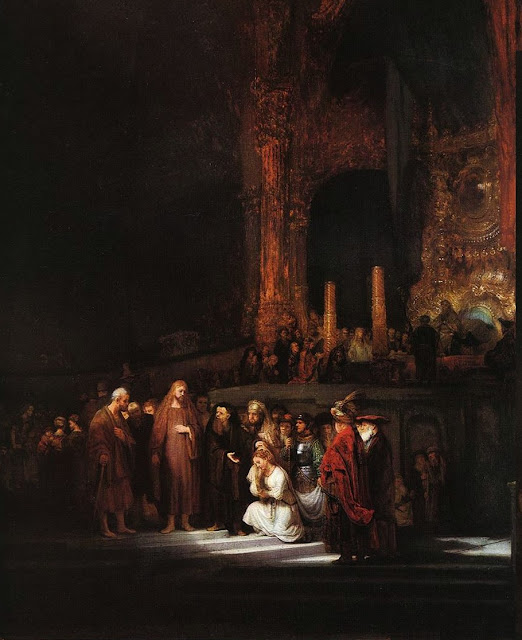
The grande marble halls were lined with majestic columns standing guard.  Although my steps were steady and dignified, I had to work hard to contain my right-before-present-opening-Christmas-morning giddiness.  Then it finally happened.  After months of anticipation, a budding (albeit one-sided) friendship was culminated.  I found myself face to face with my first Rembrandt.

I knew that the collection would be focused on the life of Jesus, but didn't know what specific paintings we would be viewing.  As we finally turned the corner and entered the exhibit,  The Woman Taken in Adultery commanded center stage.  I'm not generally quick to become teary-eyed, but in that particular moment, I found myself struggling to appear only appropriately, moderately interested.

The Woman Taken in Adultery by Rembrandt


So much about the painting is captivating.  The richness of color,  diverse cast of characters, anachronistic costumes, and barely distinguishable shapes lurking in the darkness create a scene steeped in tension and drama.  But perhaps the most startling artistic element, that which is so very Rembrantesque, is the way in which light and composition are used to guide the viewer's eye methodically through the story.  We're drawn immediately to the woman... then to the Source of Light.... and eventually back through the crowd ultimately leading to the Jewish officials.


I know enough about art (very little) to be dangerous.  But this is what I do know...


Oil paint applied to a simple 3 ft X 2 ft  oak canvas 367 years ago brilliantly summarizes the ministry of Jesus, as well as the world that he came to rescue.


Take a long look into the painting.  You'll be touched in different places of the heart than am I.  I wish we could stroll through the gallery together, pause, reflect, and process our experience over a hot cup of Starbucks.  As you'd share with me, I'd be given the gift of seeing the painting with different eyes.  Here are a few of my own observations that in turn, I'd share with you:

~Light is experienced most intensely in the presence of darkness.  

~We labor to hide our deepest, darkest selves from others.  But look into the painting.  Ultimate rest and blessing are a result of stepping into the light.

~Those lurking in the shadows "have it all together" in the eyes of their world - they are the bankers, lawyers, board members, elders of the church.  They spend their lives grateful that they aren't needy.  They have figured out how to make life work, and aren't about to let their hard-earned stability be disrupted.

~The folks "in charge" have colluded to trap the woman... in order to trap Jesus... yet he turns the tables.  The people or circumstances which seem to have control over our lives serve merely as a backdrop for real life.  There is only one who holds the position of ultimate authority.  And he is good.

~The woman caught has no defense.  She is guilty.  Blame shifting isn't an option.  All pretense, social standing, worldly security is doomed, and she has absolutely no control over the situation.   She is at the mercy of another.

The Woman Taken in Adultery is a study of contrasts:


Between pride and humility
Between judgement and grace
Between self-sufficiency and dependency
Between control and brokenness


The Woman Taken in Adultery summarizes the entire ministry of Jesus:
"He disturbs the comfortable, and comforts the disturbed." Tim Keller

Daily, we're given the choice of where we insert ourselves into the painting.  If we're really honest, most of us spend more time lurking in the shadows rather than giving up the control required to bask in the warmth of life and grace.

Are you willing to look into the painting?  
Where would you place yourself?  
Where do you want to be?

Yes, my new friend, Rembrandt, has given me a new perspective from which I can hope to see myself a bit more accurately.  As I discover dark areas in my life of which I've been previously unaware, I find that I'm guilty as well - of pride, judgement, self-sufficiency and control.  And I can't shift the blame.  Yet when I'm willing to risk exposure and emerge from the shadows,  I'm grateful to find grace, not judgement.  From the one who is ultimately in charge.  Who has all authority.  Who is good.  Who came to earth to rescue his children from the darkness of despair, sickness, broken relationships, and loneliness.  Who came to shatter the dark with light, rescue the lost, and redeem the broken. 

Sometimes we need friends to point us in the right direction... and sometimes a work of art does the trick.


~~~~~~~~~~~~~~~

Although we weren't allowed to take pictures during our visit to the Rembrandt exhibit, we were able to bring home some beautiful sketches from three different portraits of Jesus.


by Caroline - age 7


by Sam - age 10


by Will - age 12

~~~~~~~~~~~~~~~


A few resources to consider if you'd like to begin your own adventure with Rembrandt:


The Return of the Prodigal Son: A Story of Homecoming by Henri Nouwen
     Highly recommended.  This was my introduction to Rembrandt, and one of the few books I own that I've read more than once.


How Rembrandt Reveals Your Beautiful, Imperfect Self by Roger Housden
     Worth a read.  I'm at the end of this book, and it's given me much about which to think.


The Night Watch: Adventure with Rembrandt by Isabelle Lawrence
     This is a piece of historical fiction which takes place in Rembrandt's home and studio while he is commissioned to paint the Night Watch - a fun read with children). This book is out of print, but fairly easily found on Amazon or addall.com used books.


Art Museums for the Uninitiated by Russ Ramsey
     A great article about venturing into the world of art.


Rembrandt in America exhibit at the NC Museum of Art in Raleigh
     Coming November thru January


Picture Study Portfolios by Emily Cottrill
     A practical, easy to use method of becoming familiar with great artists and their work.  Each portfolio comes with a portrait and biography of the artist, eight laminated full-color works by the artist, step-by-step instructions for doing a picture study and recommended books for additional learning.  This methodology and information are equally applicable for adults and children.


My own meanderings:
Lessons from the Master:  Rembrandt's Self-Portraits and Me
Lessons from the Master: Freedom from Ties that Bind


*If the resources listed are helpful to you, please let me know, and I'll be sure to include such a list in the future when appropriate.


Saturday, October 1, 2011

Along the Road - Hutchmoot 2011

I'm a lover of life.  A glass-is-half-full girl.  A believer in ideals.  But life can be really, really hard.  And if it's not hard for me at the moment, chances are, it is for one (or many) of those close to me.  Over time, I've had the honor of walking with folks who were navigating through some treacherous territory.  They didn't see it coming, and weren't sure they'd be able to find the way out.  I've been there a time or two.  And I bet, so have you.  Thank goodness we're all here to stumble, sprint, roam, crawl, dance, climb, skip, limp and wade through life together.

In returning from my weekend at Hutchmoot, I've been pondering how and what to report back to those who've graciously shown interest.  This is my attempt.  For starters, it may be helpful to address the etymology of the name.  

Hutch - n.  A coop for the housing of small animals, especially rabbits.  
Moot - n.  An ancient English meeting, especially a meeting of the free men of a shire.  v. To discuss

Hutchmoot is the convening of 100ish music, art, Lewis and Tolkien-loving folks, many who have met virtually in the Rabbit Room. Hutchmoot is more of a family gathering than a conference.  It offers community rather than instruction.  Its intent is to inspire and enjoy rather than to equip.  

Upon returning from my weekend away, our family resumed reading Dangerous Journey, which is a beautifully illustrated retelling of Pilgrim's Progress. The story begins by introducing Christian, who carries a heavy burden upon his back.  He works with it.  He sleeps with it.  He can find no relief.  In an effort escape from certain doom, Christian embarks upon an odyssey of discovery that leads him through great peril, uncertainty, and pivotal  choices.  During his travels, he meets a variety of fellow-travelers.  Some of them, such as Obstinate, Pliable, Worldly Wiseman and Mr. Legality offer a plethora of counsel to Christian.  Their counsel, however, is unhelpful at best and near-fatal at worst.


One broad road turned to the left;  another broad road turned to the right;  while the narrow road went straight on - up the great black back of the Hill called difficulty.  Which one would they choose?  Formalist chose to go to the left, which led him into a dark wood.  Did he but know it, the road was call Danger, and he lost his way for ever.  Hypocrisy chose to go to the right, which led him into rough ground, full of holes and hummocks.  Did he but know it, the road was called Destruction.  Here he stumbled and fell, and rose no more.  As for Christian, he paused and drank at a spring to refresh himself.  Then after looking both ways, he started briskly straight up the hill.

Others join Christian and impact his journey in quite a different way.  Evangelist points him in the right direction.  The Interpreter helps him gain understanding.  Faithful, who has fought quite different battles from those Christian experienced, offers encouragement and fellowship along the way.

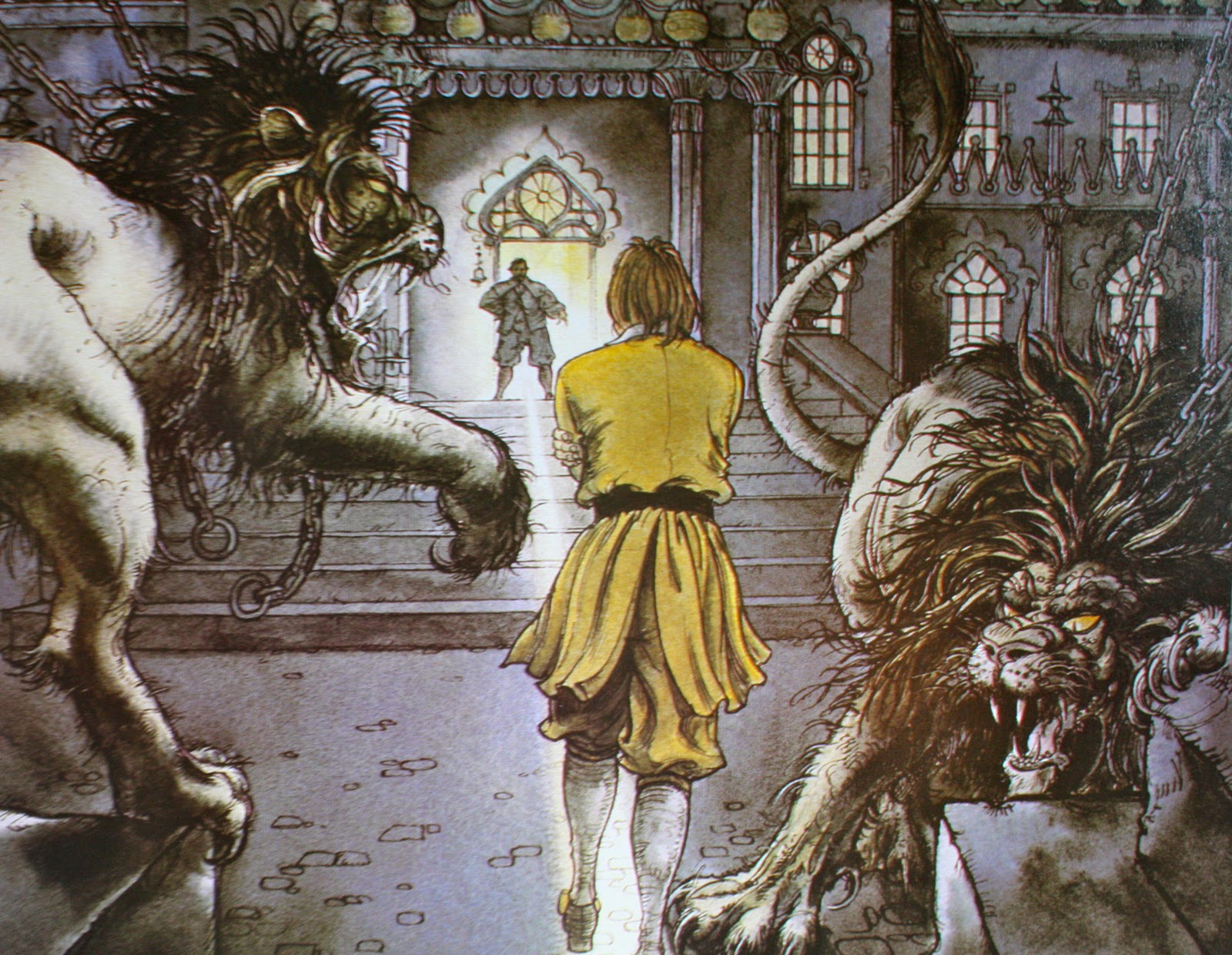
So I saw in my dream that he made great haste.  But as he drew nearer, he could hear in the darkness the roaring of the lions.  The only way forward was along a narrow passage, which was about a furlong from the porter's lodge.  This, he knew, was the place from which Mistrust and Timorous had fled.  And Christian was never so near to running back after them.  But the porter at the lodge, whose name was Watchful, perceiving now that Christian made a halt, cried out:   "Is your strength so small?  Fear not the lions.  They are on long chains.  If you keep strictly to the beam of light, in the center of the path, they cannot reach you."  So Christian moved on.  He took good heed to the directions of the porter.  At the same time, he trembled for fear of the lions, for now they were on either side of him, straining at their chains.  And how they roared, and snapped at him!  And how they tried to catch him by the foot!

Although the characters are prototypical, I can see myself in each on any given day.  At times, I offer hope, encouragement and companionship to those who are struggling.  At others, I'm presumptuous, hypocritical, timid, and not particularly helpful in encouraging my fellow-travelers to persist and press on in the right direction.  As the years go by, my hope is to become a better travel companion.

My time in Nashville was a sweet reminder that we're not left alone on this unpredictable journey of life.  Those I met did not have names like Evangelist, Faithful, or Goodwill, yet they gave me great gifts of encouragement, community, and hope.  Here are few glimpses of our encounters along the road:

~ Pete Peterson - Affirmed that just as God created in His own image, we create from our own personal stories.  Although flawed, we are born to create.  That which we create has dignity, and reflects the hope and the truth of the gospel.

~ Jonathan Rogers - Encouraged us to spend time considering our story... those moments, years, and decades in life that make up our personal history.  Within each of our lives can be found the story of redemption.  Not just in the few dramatic, life-altering scenes, yet more often in the details of the mundane.  Pay attention.  Take note.  

~ Ben Shive - Challenged us to look for stories of redemption in unlikely places.  Although that may not have been his end-goal, it was certainly a by-product of his recounting the life and works of Brian Wilson.  Who "woulda thunk"  that his music is complex and innovative, or that redemption can be seen in the story of his life.  Not in a renewal of Wilson's strength and vigor, but in the kindness of those surrounding him when he finally reached the end of his proverbial rope.  Listening to the Beach Boys will never be the same.  And hopefully, neither will listening to the stories of folks whose paths intersect with mine.  I want to listen without presumption, but with anticipation and curiosity.

~ Russ Ramsey and Justin Gerard - Illuminated the connection between the art of the masters and the Master himself.  By becoming apprentices of the great artists - studying their lives, technique, style and artwork, we can gain glimpses of the Kingdom from a new and fresh vantage point.  Gerard, who is an amazing artist and illustrator, conveyed, "I can't write like Tolkien, but I can reflect what he's done with my own art."  There's a sermon or two for us all in that statement alone.

~ Sally Lloyd-Jones - Inspired us to believe in the power of language and story, and to fall more deeply in love with The Great Story.  "A story can do much more than teach, it can transform you.  It works secretly," she shared.  Trust the story to do the work.  Don't feel like we we have to push morals.  I'm still mulling over the implications of that one.  With her humble, winsome, and delightfully British accent, Sally treated us to a lovely storybook time which could have rivaled that of the Darling children in Peter Pan.  She then narrated the story of her own life, complete with a few significant plot twists, compliments of the Author.  She inscribed my daughter's Jesus Storybook Bible with the following, "Caroline, This is your story." And it's mine.  And it's yours, too.

~ Andrew Peterson - Reminded us all to Whom we belong.  We are the beloved.  We are made in His image.  And we create as a response.  He also reminded us that we have not been left to journey through life alone.  The weekend served as a living testimony that the Kingdom is not only in the future - we've been given a taste of it here on earth.  In all of creation.  In music, art, literature, laughter, kindness, compassion, and yes, in each other.

As I continue to distill all that I experienced over the weekend in Nashville, perhaps the most lasting impression that will mark my soul was the gathering of 100 relative strangers, who because of the great love for their Father, became family.  We were given a glimpse of what will take place one day, when we are all finally gathered together "from every nation, from all tribes and peoples and languages"...


A voice cried out: "These pilgrims now are come from the City of Destruction for the love they bear to the King of this place."  So the Gates of Heaven opened to them, and they entered in.  "And," writes Bunyan in his book, "I was able to look in after them, I saw the streets were paved with gold.  And in them walked - with crowns upon their heads - the company of just men made perfect.  And the Bells of the City rang for joy.  For Christian and his fellow had come to their true home."
Amen.


All pictures and quotations are borrowed from Dangerous Journey:  The Story of Pilgrim's Progress William B. Eerdmans Publishing Company