Showing posts with label Rembrandt. Show all posts

Friday, October 14, 2011

Lessons from the Master: A Study in Contrast

The grande marble halls were lined with majestic columns standing guard.  Although my steps were steady and dignified, I had to work hard to contain my right-before-present-opening-Christmas-morning giddiness.  Then it finally happened.  After months of anticipation, a budding (albeit one-sided) friendship was culminated.  I found myself face to face with my first Rembrandt.

I knew that the collection would be focused on the life of Jesus, but didn't know what specific paintings we would be viewing.  As we finally turned the corner and entered the exhibit,  The Woman Taken in Adultery commanded center stage.  I'm not generally quick to become teary-eyed, but in that particular moment, I found myself struggling to appear only appropriately, moderately interested.
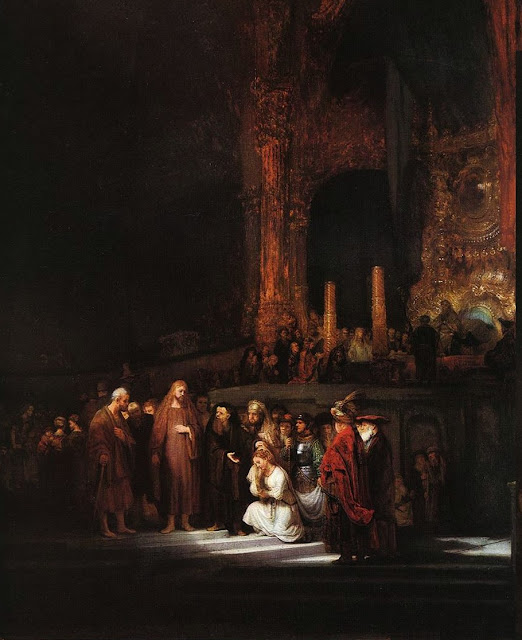
The Woman Taken in Adultery by Rembrandt


So much about the painting is captivating.  The richness of color,  diverse cast of characters, anachronistic costumes, and barely distinguishable shapes lurking in the darkness create a scene steeped in tension and drama.  But perhaps the most startling artistic element, that which is so very Rembrantesque, is the way in which light and composition are used to guide the viewer's eye methodically through the story.  We're drawn immediately to the woman... then to the Source of Light.... and eventually back through the crowd ultimately leading to the Jewish officials.


I know enough about art (very little) to be dangerous.  But this is what I do know...


Oil paint applied to a simple 3 ft X 2 ft  oak canvas 367 years ago brilliantly summarizes the ministry of Jesus, as well as the world that he came to rescue.


Take a long look into the painting.  You'll be touched in different places of the heart than am I.  I wish we could stroll through the gallery together, pause, reflect, and process our experience over a hot cup of Starbucks.  As you'd share with me, I'd be given the gift of seeing the painting with different eyes.  Here are a few of my own observations that in turn, I'd share with you:

~Light is experienced most intensely in the presence of darkness.  

~We labor to hide our deepest, darkest selves from others.  But look into the painting.  Ultimate rest and blessing are a result of stepping into the light.

~Those lurking in the shadows "have it all together" in the eyes of their world - they are the bankers, lawyers, board members, elders of the church.  They spend their lives grateful that they aren't needy.  They have figured out how to make life work, and aren't about to let their hard-earned stability be disrupted.

~The folks "in charge" have colluded to trap the woman... in order to trap Jesus... yet he turns the tables.  The people or circumstances which seem to have control over our lives serve merely as a backdrop for real life.  There is only one who holds the position of ultimate authority.  And he is good.. 

~The woman caught has no defense.  She is guilty.  Blame shifting isn't an option.  All pretense, social standing, worldly security is doomed, and she has absolutely no control over the situation.   She is at the mercy of another.

The Woman Taken in Adultery is a study of contrasts:


Between pride and humility
Between judgement and grace
Between self-sufficiency and dependency
Between control and brokenness


The Woman Taken in Adultery summarizes the entire ministry of Jesus:
"He disturbs the comfortable, and comforts the disturbed." Tim Keller

Daily, we're given the choice of where we insert ourselves into the painting.  If we're really honest, most of us spend more time lurking in the shadows rather than giving up the control required to bask in the warmth of life and grace.

Are you willing to look into the painting?  
Where would you place yourself?  
Where do you want to be?

Yes, my new friend, Rembrandt, has given me a new perspective from which I can hope to see myself a bit more accurately.  As I discover dark areas in my life of which I've been previously unaware, I find that I'm guilty as well - of pride, judgement, self-sufficiency and control.  And I can't shift the blame.  Yet when I'm willing to risk exposure and emerge from the shadows,  I'm grateful to find grace, not judgement.  From the one who is ultimately in charge.  Who has all authority.  Who is good.  Who came to earth to rescue his children from the darkness of despair, sickness, broken relationships, and loneliness.  Who came to shatter the dark with light, rescue the lost, and redeem the broken. 

Sometimes we need friends to point us in the right direction... and sometimes a work of art does the trick.


~~~~~~~~~~~~~~~

Although we weren't allowed to take pictures during our visit to the Rembrandt exhibit, we were able to bring home some beautiful sketches from three different portraits of Jesus.


by Caroline - age 7


by Sam - age 10


by Will - age 12

~~~~~~~~~~~~~~~


A few resources to consider if you'd like to begin your own adventure with Rembrandt:


The Return of the Prodigal Son: A Story of Homecoming by Henri Nouwen
     Highly recommended.  This was my introduction to Rembrandt, and one of the few books I own that I've read more than once.


How Rembrandt Reveals Your Beautiful, Imperfect Self by Roger Housden
     Worth a read.  I'm at the end of this book, and it's given me much about which to think.


The Night Watch: Adventure with Rembrandt by Isabelle Lawrence
     This is a piece of historical fiction which takes place in Rembrandt's home and studio while he is commissioned to paint the Night Watch - a fun read with children). This book is out of print, but fairly easily found on Amazon or addall.com used books.


Art Museums for the Uninitiated by Russ Ramsey
     A great article about venturing into the world of art.


Rembrandt in America exhibit at the NC Museum of Art in Raleigh
     Coming November thru January


Picture Study Portfolios by Emily Cottrill
     A practical, easy to use method of becoming familiar with great artists and their work.  Each portfolio comes with a portrait and biography of the artist, eight laminated full-color works by the artist, step-by-step instructions for doing a picture study and recommended books for additional learning.  This methodology and information are equally applicable for adults and children.


My own meanderings:
Lessons from the Master:  Rembrandt's Self-Portraits and Me
Lessons from the Master: Freedom from Ties that Bind


*If the resources listed are helpful to you, please let me know, and I'll be sure to include such a list in the future when appropriate.




Saturday, September 17, 2011

Lessons from the Master (part 2 of 2): Freedom from Ties that Bind


"The Painter in His Studio" by Rembrandt


Rembrandt van Rijn is undoubtedly considered one of the Great Masters of painting and etching.  As with all of us, his life was marked by both success and tragedy.  He suffered the death of his wife and 3 of his 4 children, and endured significant scandal and bankruptcy. It would be reckless to hold Rembrandt up as the standard for which we should strive, yet there is merit to gleaming insights from his remarkable life. 


During his career, Rembrandt received a fair degree of criticism for his unconventional methodologies. Ironically, it was often this deviation from the norm that resulted in the extraordinary nature of his artwork.  Some say he was intentionally "bucking the system."  I'd suggest that his motivation was not externally motivated defiance.  Rather, he was intensely determined to be true to self.  

“Instead of being commissioned, the subjects for most of his works were chosen by Rembrandt himself.  Other contemporary portrait painters, like Van Dyck, Velazquez, or Hals, worked almost exclusively on commission, which meant they had to abide by the narrow restrictions on the form imposed by the expectations of the sitter.  Make me look good, whatever you do.”  Roger Housden

Rather than painting in order to please patrons, Rembrandt honored his sense of creative expression.  He chose artistic integrity over financial security.  Some of his most moving and memorable works were produced as a result of the resulting creative freedom.  He painted in order to reveal souls, not capture images.  Holland was a magnet for refugees, and many of his subjects were poor Jewish neighbors (he was the first of his time to paint Jesus as a young Jewish man).  He captured the moods of everyday people as they went about in ordinary life – teaching a toddler to walk, cleaning, and sleeping.   All because he was free from the ties that come with needing to please others.

I’d imagine that if Rembrandt had restricted his artwork to the parameters set by patrons, his paintings still would have been remarkable.  We simply would have never  known that we missed the best part of him.  The same is true of our lives - although seemingly fruitful from the outside, we often don't experience the fullness of life that we were intended to live.  We too, miss the best part.

I’m challenged by the contrast of Rembrandt’s freedom with my frequent bondage to the opinion of others, and to the commitment  to make life work on my terms.  I want a life freedom, yet find myself bowing down to the idols of approval and control.  The struggle is revealed daily…

~ When I find myself angry with my older children for making poor choices, or with my young children when they exhibit less-than-expected manners.  Not always because I want what is honoring to God, but at times because I want affirmation that we’re good parents.  Rather than live a life marked by patience and encouragement, I become a slave to approval.

~ When I’m not willing to go to my husband and ask for forgiveness after an argument, even when I know  that I was in the wrong.  Rather than living a life marked by love and freedom, I become a slave to the illusion of control.

~ When I maintain a safe distance from friends instead of entering into the messiness of relationship.  Rather than living a life marked by integrity and long-suffering, I become a slave to the attainment of safety and acceptance.

I want to live a life marked by peace, integrity, humility, and vibrancy.

Yet I also want to win the approval of others, control of my life, and experience safety in relationships – all which come with strings attached.  Ties that bind.  Chains that enslave.   By my own hand.

We see the cycle of bondage as it played out in Israel’s history.  Until they were delivered.  


We are still in need. 


I am still in need…

Our enemy, our captor is no pharaoh on the Nile
Our toil is neither mud nor brick nor sand
Our ankles bear no calluses from chains, yet Lord, we're bound
Imprisoned here, we dwell in our own land

Deliver us, deliver us
Oh Yahweh, hear our cry
And gather us beneath your wings tonight

Our sins they are more numerous than all the lambs we slay
These shackles they were made with our own hands
Our toil is our atonement and our freedom yours to give
So Yahweh, break your silence if you can

Andrew Peterson “Deliver Us”

The majority of us will not leave a portfolio of priceless artwork for which we will be remembered.  Our legacy will be more subtle, yet no less significant than that of Rembrandt’s.  We’ve each been given a unique palette of talents, experiences, and predispositions with which we paint upon the canvas of the world.  We leave our mark on those we meet, indelibly altering the composition and tone of their lives.  


Daily, we choose for whom we are painting.  


Do I take the talents and abilities that I’ve been given to fulfill the expectations of others (or myself)? In doing so, I become a slave to that which I hope to attain.


Or do I choose to live life as a student of the Master?  Trusting his guidance, studying his ways, and painting to please him alone...  and as a result, leaving behind a legacy that bears a resemblance to the Master himself.  

“It is for freedom that Christ has set us free.  Stand firm, then and do not let yourselves be burdened by a yoke of slavery.”  Galatians 5:1


Sunday, September 4, 2011

Lessons from the Master (part 1of 2): Rembrandt's Self-Portraits and Me

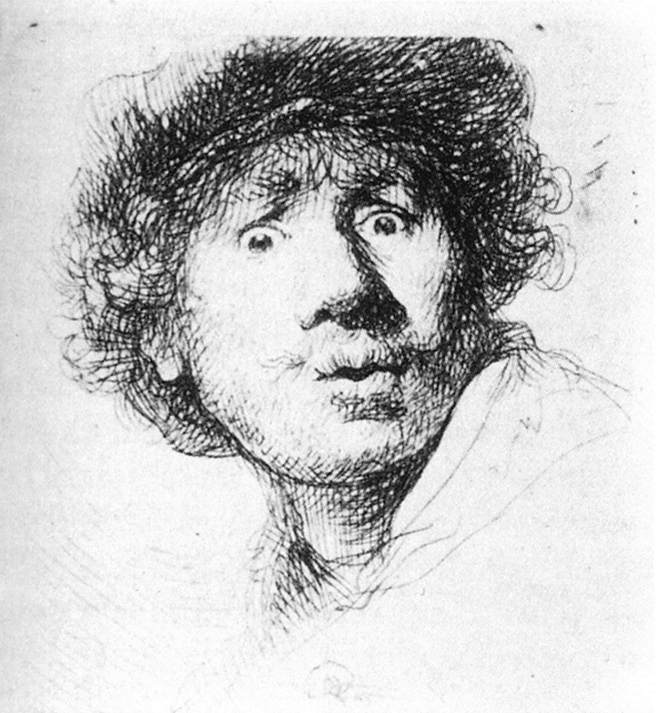
Rembrandt, Self-Portrait in a Cap, Open-Mouthed, 1630, etching


Art was one of those classes I took to offset my load of “real” course work. The teacher was straight out of the textbook.  Perhaps my memory is tainted, but he really did look like Van Gogh, minus the bandaged ear.  He was a quirky, melancholy, disheveled man who became highly animated when he talked about artwork.  I don’t remember much from class other than sketching leaves, a tennis shoe, and shadowed 3-dimensional blocks.  The most lasting instruction I received from Van Gogh was:  “Don’t ever say that a painting is pretty.”  The humble beginnings of my art appreciation education.

One of the perks of our homeschooling lifestyle is the freedom, flexibility, and capacity to step out of the mainstream pace of life and delve deeply into whatever we’re studying.  We’ve begun a (one-sided) relationship with Rembrandt Van Rijn.  As with any relationship, we’re in the early stages of turning over various pieces of the puzzle of his life and artwork, and studying them individually.  Each gives a glimpse of the larger, finished project.  As a side note, I’m struck that even if we had lived down the street from him, shared dinners and holidays, and had the ability to talk with him over a hot cup of Dutch koffie, we’d still limited in how well we could know him.  That’s just the way we’re created – as a bottomless box of puzzle pieces.  No matter how many are plucked out, studied, and meticulously rearranged, only the Creator has the vision to see us in our entirety.  I find it somewhat humorous that we think we have each other “figured out.”

But back to Rembrandt… One of the puzzle pieces we’ve pulled out of the box is his uncanny use of light and shadow.  Another is his tendency to buck the convention of the time when painting groups of people.  Rather than paint a series of portraits all on the same canvas, he created a storyline of characters.  His paintings evoke emotion and questions:  “What were they talking about?”  “Who was the man in the shadows?”  “What was she feeling?”  The famous Night Watch was one of those controversial paintings in which Rembrandt created a compelling scene rather than a string of flat portraits.  Not all of his subjects were pleased. Some actually demanded their money back.

Personally, one of the most compelling pieces of the Rembrandt puzzle has been his remarkable insight into human emotion.  His paintings draw you to the souls of the subject.  This unique characteristic of his artwork leaves us with an obvious question:  How did he know so much about the nature of people?

In the 50 years of Rembrandt’s career, he produced more than 90 self-portraits.  He became a student of himself  - not only studying the detail of his physical being, but also exploring the complexities and diversity of human emotion. His discovery of self was not rooted in self-absorption.  Artists who were narcissistic tended to paint themselves repeatedly in their best form.  Rembrandt, however, exposed his heart as both kind and enraged, his mind as both theatrical and analytical, and his disposition as both carefree and pensive.  He used self-study as a tool to gain insight into the full range of the human condition.  And the result was his remarkable ability to capture an extensive range emotional and psychological aspects on canvas.  He deliberately explored and discovered self for the purpose of gaining in-depth insight into others.

So what lesson can we learn from the master?

We live in a society that has written reams of self-help books, booming syndication of Dr. Phil and Oprah, and promises fulfillment if only you can identify and achieve  whatever it is that makes you happy.  Self-examination and self-help are in vogue.  However, I’d argue that the motivation and methodology behind most of today's approaches to self-exploration differ greatly from Rembrandt’s.  And from the Master’s as well.

How can you say to your brother, “Let me take the speck out of your eye,” when all the time there is a plank in your own eye?  You hypocrite, first take the plank out of your own eye, and then you will see clearly to remove the speck from your brother’s eye. Matthew 7:4-5

Having an accurate self-assessment is one of the first steps to loving others well.  We all have some form of plank that blocks our view.  The plank can take the form of arrogance or shame. It can masquerade as intellect, discernment, religion, or volunteer service.  It’s anything that distorts the Truth of who we are,  and it in turn distorts our view of others.  If we’re willing to acknowledge the plank, then to have it removed bit by bit, the process is painful yet the result is freeing.  I’ve shared a bit of my own journey here, and I hope to continue undergoing the process of log-extraction as long as I have breath. Although there will always be remnants of the log this side of heaven, our eyesight can be greatly restored.  As we begin to see more clearly, we are enabled to love others in a way that more closely resembles the love of the Father.  In short, we can begin to get ourselves out the way, and let Him love others through us.  


An unsolicited, unpaid-for, no kick-back, but straight-from-the-heart advertisement:  


For those of you who live in Charlotte and would like to spend some focused energy on the art of walking through life with others, I’d highly recommend your consideration of Barnabas Training.   This powerful approach utilizes reading, writing, group and individual discussions to help us discover "the log in our own eye" so that we are better equipped to see more clearly and love others well.