Showing posts with label faith. Show all posts

Wednesday, February 22, 2012

Curiosity for Lent


Having grown up in a small town in the mountains of Tennessee, my worldview was largely shaped by the individual faces in our small community.  I had one friend who was Jewish.  One was Catholic.  One who wasn’t aloud to wear shorts because they were too revealing.  Another who actually took her Bible to church.  These differences never caused division – they simply provided the adjectives with which each family was described. 

Friends' distinctive religious celebrations brought a welcome  diversity into a fairly homogenous community.  To attend a bat mitzvah in our little town felt somewhat cosmopolitan.   The cross of ashes worn on the forehead of a few classmates evoked a subtle sense of mystery.  We respected the differences of our faiths.  However, to cross over the line between respecting and learning from one another felt too bold and uncertain.  


As a young adult, my experience of God shifted from one of inherited religion to one of chosen relationship.  Gradually, I began to suspect that I might have something to learn from the different ways in which others encountered, experienced, and worshiped God. I wanted His life, His teachings, and His ultimate death and resurrection to be more than an intellectual assent or a religious practice. I was not longer content to just know about Him.   I wanted to know Him.  

An attempt to move beyond wanting toward knowing came shortly after I graduated from college.  Every Wednesday during Lent, I slipped out of my office at the bank and walked down the street to attend a church service.  The choice in church was not deliberate or intentional - it's location and schedule simply made attendance relatively easy.  Each sermon focused on one of the people involved in the Passion of Jesus. Preparing for Christmas had been an expected part of my annual tradition. Preparing for Easter had not.  Intentionally altering my routine, in order to focus my heart, changed my experience of the season.  It changed me.

As we consider the world in which Jesus walked, he encountered primarily two kinds of people.  Those who held so tightly to their systems of religion and life that they missed Him, and those who were curious enough to follow.  As we embark on the season of Lent, we all bring our childhood history, our adult experiences, our preconceptions, and our annual rituals (or lack thereof) along with us.  Although these bring a sense of tradition and security, I wonder what it would look like if we allowed ourselves to become curious...  


~ Curious about how others commemorate the next 40 days  
~ Curious about the “whys” behind the Lenten traditions practiced by others 
~ Curious enough, perhaps, to slip into a service at a different church, read a new book, or alter our routine in some way to make more room in our hearts for the season ahead.   And ultimately, to make more room in our hearts for the One who came to rescue us from ourselves.


I want to see Him with fresh eyes.  


I didn't grow up in, nor do we currently attend, a liturgical church which formally celebrates the season of Lent.  However, I look forward to the next four weeks with great anticipation. We'll be reading as a family, I'll be reading on my own, and we plan to attend Vespers at a local Abbey.  Our choices will most likely differ from yours, yet the hope is that we all approach this season not with a sense of duty or habit, but with a renewed sense of wonder and curiosity.  

~~~~~~~~~~

A few suggestions if you’re looking for books:

If you have children, or enjoy reading historical fiction, I’d highly recommend reading Arnold Yuletide’s book, Amon’s Adventure.  Written by the author of the Advent series Jotham’s Journey, each of the 28 chapters is a great read-aloud which provides fodder for rich conversation and reflection.  It paints a vibrant picture of the political, social, and religious climate in which Jesus lived.  Amon's Adventure illuminates the complexity and confusion Jesus' ministry brought to those who loved and were trying to obey Yahweh.  Jesus wasn't what they were expecting. That same tension exists to some level for all of us today.


This year, I have discovered and soaked myself in the writings of Walter Wangerin, Jr.  I referenced the book Miz Lil and the Chronicles of Grace in my “Top 10 List” for 2011, and I’ve been lining up his books in my reading queue ever since.  I started reading this morning.   


Life of the Beloved by Henri Nouwen has become one of those staple books in our library to which I return again and again.


I'd love to hear from anyone who is willing to share books, resources, or traditions that have been meaningful to you during this Lenten season.  You'll be an encouragement to others.  Perhaps you'll peak their curiosity.  Blessings to you and yours.

Thursday, December 8, 2011

Twin Towers and a Manger

Out of the wreckage...


Where were you?


I was sitting on the floor of my bedroom holding my beautiful  one-week-old son.  We had only been home from the hospital for a few days, and I was fully intoxicated with the sweet smells of newly-bathed baby, the feel of his slow, steady breathing on my neck, and the slight, warm pressure of eight pounds of perfection curled up and sleeping on my chest.  My two year old was playing contentedly in the corner with his plastic pet shop, a left-over rediscovered toy, compliments of his big sister.  Having been up most of the night, I had traded in my feeble attempt at reading a book for watching Regis and Kelly on the TV.  The air drifting through my cracked window carried with it the hint of the last days of summer.   Life was sweet.  Simple.  Full.


Then it happened.  Within moments, life as we had known it would be changed forever.  It was September 11, 2001, and my dependable, soothing slice of broadcasted Americana was suddenly interrupted with footage of the first plane hitting the tower.  I couldn't believe what I had seen, and I certainly had no idea the lasting impact that the events of that balmy September morning would have on our nation.  On our family.  On the lives of generations to come.  Literally out of the blue, we had all been affected at the most visceral level.


According to a ten-year anniversary article "How 9/11 Changed our Culture" (US News),  our lives were changed in a number of ways including:


~How we speak
~What we fear
~How we keep safe
~What entertains us
~What we read
~Who we admire


We would never look at the world in the same way, and the choices we made going forward would reflect our shift in perspective.


Over 2,000 years ago, the Roman Empire was enjoying a relatively peaceful political climate compliments of the Pax Romana.  The Empire protected and governed its provinces, and the Jewish religion was generally tolerated.  Although there were divisions within the Jewish schools of thought, most had learned to live peacefully under Roman control.  Life was manageable.  They knew what to expect.


Then, one very normal night, the course of history changed forever.  There had been no word from God in over 400 years.  But suddenly, that changed.  At a given point in time, in an unimpressive town, to two ordinary people, the Creator of the world transcended space and time to pierce through the veil between heaven and earth and become one of us.  Literally out of the dark, we would all be affected at the most visceral level.


For those who were present that night and witnessed the divine becoming human, for those who would follow the carpenter's son and listen to his teaching, and for those who would choose to exchange control of their lives in order to serve the unlikely king, the world as they had known it would forever be different.


They would never look at the world the same way, and the choices they would make going forward would reflect their shift in perspective.


A few months ago, we commemorated the tenth anniversary of 9/11.  Footage of the planes was dusted off and replayed across the airwaves, memorial services were held, and we all paused to remember.  As I was recounting that pivotal day's events to my sweet baby boy, now 10 years old, I found that a curious phenomenon had transpired.  On the spectrum that ranges from intense experience all the way to detached, my emotion had shifted a few notches.  I'm sure that if I'd lost a loved one during the tragedy, my reaction would have been different.  But for me, the events that had once singed my soul had been quenched through the last ten years, and they were incrementally closer to becoming memorable dates in an American history book.


Time had lessened the emotional impact.  I had become more detached.  The full impact of 9/11 had been diminished.


Unfortunately, the same can often be said of Christmas.


We mark the calendar, attend the performances, religiously decorate our homes, and pause to remember. 


But I long for more.


~I want to feel deeply... not just remember
~I want to look at the world from His perspective... not my limited viewpoint
~I want to believe that the God of the universe is present, relevant, revolutionary in every aspect of my life


Ten years ago, darkness penetrated and impacted the soul of our country.

Two thousand years ago, Light penetrated our dark world and changed it forever.

Yes, we remind one another that he came as a baby in the manger.  The shepherds followed the star.  The wise men came later, bearing gifts.  


But this Christmas, let us not be satisfied to "just remember."  Rather than settling for an annual observation filled with the good things of sentiment, warm tidings, advent readings and tradition, let them serve to magnify the ultimate things.  Perhaps it would help to remember...


Where were you?  


When the story became real.  When you first believed.  When the Maker of the moon and the Author of the faith penetrated your independent, self-reliant heart and changed it forever.  I was on a stone bench overlooking a small lake.  It was late at night, but I could strain my eyes just enough to see white swans gliding through the water - beacons of light in the midst of the dark.  Because of the baby born so long ago, my life was forever changed. And I never want to forget.


~~~~~~~~~~

I first heard Jill Phillips sing this three years ago on The Behold the Lamb of God tour, and I still get chills every time I hear it.  Take a few minutes to listen...


Friday, October 28, 2011

Houston, We Have a Problem

Taken from Apollo 13 during the crisis

Last weekend, we watched Apollo 13 with our younger boys for the first time.  I’ve seen it before, but what a treat to see it through their eyes.  Together, we felt the eager anticipation of three astronauts who had labored throughout their careers with the ultimate goal in mind – to walk on the surface of the moon.   Since the inaugural landing had taken place months earlier, Americans were no longer captivated by the endeavor.  What had once seemed unimaginable had quickly become last year's news.  For the astronauts of Apollo 13, however, their eyes were fixed on the goal.  It was to be their turn.  

The entire team of engineers, astronauts, and those on ground control had planned for every conceivable contingency.  They knew that problems could arise, and they had planned accordingly.  Early in their flight, a mishap did indeed occur.  They took it in stride, then were grateful that “our glitch for the mission was over.”  Within minutes, however, everything changed.  “Houston, we have a problem.”  

 The story rapidly unfolded as the three astronauts realized that their ultimate goal of walking on the moon was no longer a possibility.  In fact, it became clear that their return to earth would be somewhat of a miracle.    We were drawn into their tight quarters, felt the loss of power, and more acutely, the loss of control.  No one had conceived that such a multi-system failure could occur.  There was no contingency plan for a disaster of this magnitude.  In the midst of the crisis, they were all forced to disband the plan for what should have been, and to go back to the proverbial drawing board.

“It wasn’t supposed to be like this.”  I’ve said it.  Perhaps you have as well.  We anticipate disruptions in life.  We know they can happen and plan accordingly.  We buy the right insurance, secure the right job, marry the right person, and discipline our kids according the philosophy of the day. We’re not naive – we know that we’ll have our glitches along the way, but acknowledge piously that those problems will make us stronger.  Until one very ordinary day, we’re not facing another malfunction to be repaired, but have suddenly found ourselves drifting in space as the result of a potentially lethal explosion.  We certainly didn’t see it coming, and couldn’t possibly have planned our own remedy in advance.

~Death of a loved one
~Infidelity
~A defiant, rebellious child
~Serious Illness
~Loss of financial security

We travel through life anticipating our own version of walking on the moon – the day when all of our hard work will finally pay off.  But in the blink of an eye, everything can change…

Houston, we have a problem.

As the crew became aware of the situation’s severity, a chain reaction of emotion was instigated.  Within minutes, there was an awareness that the pinnacle for which they had trained through the years, would never be reached.  They would not walk on the moon.  This realization brought with it gut-wrenching grief as life-long dreams literally disappeared into vapor. 

Then came the dramatic shift. 

They had to leave behind the dream of “what should have been” in order to accept “what actually was.”

It was only after that pivotal decision that they were able to move forward.  The goal of walking on the moon, which had once felt paramount, instantly became insignificant.  Perspective had changed radically.  The chance of survival was slim.

Alone, they were helpless.  Completely at the mercy of the ground crew which was working frantically to come up with a solution, the astronauts had to wait.  In silence.  In darkness.  In the cold.  Have you been there?  I have, and it’s a terrifying to be thrust into the reality of our own limitations.  

They had to reorient themselves:

~by scrapping the original plan
~by redefining their goal
~by letting go of control and following the direction of another

After days of peril and excruciating uncertainty, the astronauts were successfully brought back home.  That which had once seemed routine became priceless.  Not one of the three ever walked on the moon, but as they let go of "what should be," they were free to discover the miracle of what actually was.

“This could be the worst disaster NASA’s ever faced,” lamented the NASA Program Director.  True.  But not the end of the story.  The Flight Director responded, “With all due respect, sir, I believe this is gonna be our finest hour.”  

And it was. 

From the ashes of great crisis, beauty can indeed rise.

And one day, we've been promised, that it will.

~~~~~~~~~~

Intensive investigation revealed that the near-fatal malfunction was a result of a production error 4 years prior to the Apollo 13 flight.  Any blame-shifting or finger pointing during the crisis had been misplaced.  It became clear that the error was not caused by either the astronauts on board or the crew on the ground.  They were all the unfortunate heirs of a pre-existing faulty condition.  

Paul in 2 Corinthians 4: 8 says: "We are afflicted in every way, but not crushed; perplexed, but not in despair."

*The word for perplexed in the original means "no way through" and the word for despair is the same word intensified meaning " utterly without any way through".

We can trust the Lord to find a way through for us in all circumstances so that whereas we may be stumped, not seeing any way forward though our problems, He will never let us be persuaded that there is absolutely no way through. He will keep us from despair. He will provide the promised way out. (1 Cor 10:13 )
*Borrowed from Ieuan LLoyd-Jones 


Friday, October 14, 2011

Lessons from the Master: A Study in Contrast

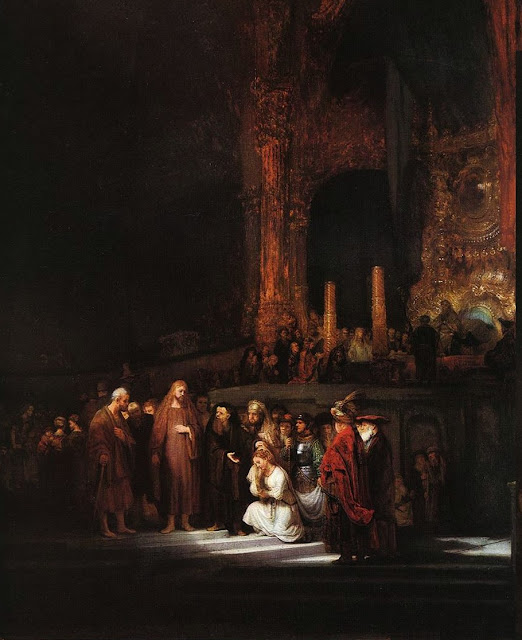
The grande marble halls were lined with majestic columns standing guard.  Although my steps were steady and dignified, I had to work hard to contain my right-before-present-opening-Christmas-morning giddiness.  Then it finally happened.  After months of anticipation, a budding (albeit one-sided) friendship was culminated.  I found myself face to face with my first Rembrandt.

I knew that the collection would be focused on the life of Jesus, but didn't know what specific paintings we would be viewing.  As we finally turned the corner and entered the exhibit,  The Woman Taken in Adultery commanded center stage.  I'm not generally quick to become teary-eyed, but in that particular moment, I found myself struggling to appear only appropriately, moderately interested.

The Woman Taken in Adultery by Rembrandt


So much about the painting is captivating.  The richness of color,  diverse cast of characters, anachronistic costumes, and barely distinguishable shapes lurking in the darkness create a scene steeped in tension and drama.  But perhaps the most startling artistic element, that which is so very Rembrantesque, is the way in which light and composition are used to guide the viewer's eye methodically through the story.  We're drawn immediately to the woman... then to the Source of Light.... and eventually back through the crowd ultimately leading to the Jewish officials.


I know enough about art (very little) to be dangerous.  But this is what I do know...


Oil paint applied to a simple 3 ft X 2 ft  oak canvas 367 years ago brilliantly summarizes the ministry of Jesus, as well as the world that he came to rescue.


Take a long look into the painting.  You'll be touched in different places of the heart than am I.  I wish we could stroll through the gallery together, pause, reflect, and process our experience over a hot cup of Starbucks.  As you'd share with me, I'd be given the gift of seeing the painting with different eyes.  Here are a few of my own observations that in turn, I'd share with you:

~Light is experienced most intensely in the presence of darkness.  

~We labor to hide our deepest, darkest selves from others.  But look into the painting.  Ultimate rest and blessing are a result of stepping into the light.

~Those lurking in the shadows "have it all together" in the eyes of their world - they are the bankers, lawyers, board members, elders of the church.  They spend their lives grateful that they aren't needy.  They have figured out how to make life work, and aren't about to let their hard-earned stability be disrupted.

~The folks "in charge" have colluded to trap the woman... in order to trap Jesus... yet he turns the tables.  The people or circumstances which seem to have control over our lives serve merely as a backdrop for real life.  There is only one who holds the position of ultimate authority.  And he is good.. 

~The woman caught has no defense.  She is guilty.  Blame shifting isn't an option.  All pretense, social standing, worldly security is doomed, and she has absolutely no control over the situation.   She is at the mercy of another.

The Woman Taken in Adultery is a study of contrasts:


Between pride and humility
Between judgement and grace
Between self-sufficiency and dependency
Between control and brokenness


The Woman Taken in Adultery summarizes the entire ministry of Jesus:
"He disturbs the comfortable, and comforts the disturbed." Tim Keller

Daily, we're given the choice of where we insert ourselves into the painting.  If we're really honest, most of us spend more time lurking in the shadows rather than giving up the control required to bask in the warmth of life and grace.

Are you willing to look into the painting?  
Where would you place yourself?  
Where do you want to be?

Yes, my new friend, Rembrandt, has given me a new perspective from which I can hope to see myself a bit more accurately.  As I discover dark areas in my life of which I've been previously unaware, I find that I'm guilty as well - of pride, judgement, self-sufficiency and control.  And I can't shift the blame.  Yet when I'm willing to risk exposure and emerge from the shadows,  I'm grateful to find grace, not judgement.  From the one who is ultimately in charge.  Who has all authority.  Who is good.  Who came to earth to rescue his children from the darkness of despair, sickness, broken relationships, and loneliness.  Who came to shatter the dark with light, rescue the lost, and redeem the broken. 

Sometimes we need friends to point us in the right direction... and sometimes a work of art does the trick.


~~~~~~~~~~~~~~~

Although we weren't allowed to take pictures during our visit to the Rembrandt exhibit, we were able to bring home some beautiful sketches from three different portraits of Jesus.


by Caroline - age 7


by Sam - age 10


by Will - age 12

~~~~~~~~~~~~~~~


A few resources to consider if you'd like to begin your own adventure with Rembrandt:


The Return of the Prodigal Son: A Story of Homecoming by Henri Nouwen
     Highly recommended.  This was my introduction to Rembrandt, and one of the few books I own that I've read more than once.


How Rembrandt Reveals Your Beautiful, Imperfect Self by Roger Housden
     Worth a read.  I'm at the end of this book, and it's given me much about which to think.


The Night Watch: Adventure with Rembrandt by Isabelle Lawrence
     This is a piece of historical fiction which takes place in Rembrandt's home and studio while he is commissioned to paint the Night Watch - a fun read with children). This book is out of print, but fairly easily found on Amazon or addall.com used books.


Art Museums for the Uninitiated by Russ Ramsey
     A great article about venturing into the world of art.


Rembrandt in America exhibit at the NC Museum of Art in Raleigh
     Coming November thru January


Picture Study Portfolios by Emily Cottrill
     A practical, easy to use method of becoming familiar with great artists and their work.  Each portfolio comes with a portrait and biography of the artist, eight laminated full-color works by the artist, step-by-step instructions for doing a picture study and recommended books for additional learning.  This methodology and information are equally applicable for adults and children.


My own meanderings:
Lessons from the Master:  Rembrandt's Self-Portraits and Me
Lessons from the Master: Freedom from Ties that Bind


*If the resources listed are helpful to you, please let me know, and I'll be sure to include such a list in the future when appropriate.


Sunday, August 28, 2011

Glass Full


Last week, my husband and I attended a dinner party with several other couples – some of whom we had known for years, and some who we didn’t know at all.  It was a relational group – conversations flowed easily, and we made connections of mutual friends, colleges, churches, and interests that could have been charted like a constellation map.  Eventually, we migrated to the living room to congregate over dessert.  The “get to know you” question of the evening:  “As a couple, what has been the highlight and what has been the lowlight of the year?” It shouldn’t have been a particularly difficult question to answer.  The couples were given a few minutes to discuss with each other prior to answering in the larger group (the hosts, by the way, were counselors and knew this to be wise).  I was stopped.  Not by the question, but by my scrambling for an answer.

Like a mad woman searching frantically for keys that I was sure I had just seen, I found myself digging through my purse full of memories from the last year.  Surely there was a major disappointment somewhere.  I was able to surface the highlights rather quickly.  But to my own surprise, I couldn’t seem to locate the doubtless difficult times with the same ease.  I’m well aware that life is a grab-bag full of good and bad, and that some folks seem to  beat the odds regarding pulling out more prizes than duds, at least from appearances.  But our history, although peppered with some delightful treasures, has been one with considerable struggle.  Wow.  Perhaps this year has been different.

I finally came around to acknowledging that this year has indeed been one of unexpected respite.  Isn’t this what we’ve been waiting for?  A season filled with richness of experience, joyful celebration, and relative peace.  The glass was unusually full.  Then why did I have a faint feeling of sadness like a microscopic crack threatening to siphon my merriment, drop by drop?  Then it slowly dawned upon me.  I had a vague sense that I've felt this way before.

~ As I watched my beautiful newborn sleep, I reveled in inexplicable delight… yet I secretly feared that he may not wake up

~ When a year’s worth of uncertainly came to an end, resulting in our stay in Charlotte, a new job, and a move to a wonderful neighborhood…  as we sighed with relief, there was an underlying “what if we loose this?”

~ When medical tests returned negative – an up-to-date affirmation that I was healthy… but what about next time?

"Our life is a short time in expectation, a time in which sadness and joy kiss each other at every moment. There is a quality of sadness that pervades all the moments of our lives. It seems that there is no such thing as a clear-cut pure joy, but that even in the most happy moments of our existence we sense a tinge of sadness. In every satisfaction, there is an awareness of limitations. In every success, there is the fear of jealousy. Behind every smile, there is a tear. In every embrace, there is loneliness. In every friendship, distance. And in all forms of light, there is the knowledge of surrounding darkness . . . But this intimate experience in which every bit of life is touched by a bit of death can point us beyond the limits of our existence. It can do so by making us look forward in expectation to the day when our hearts will be filled with perfect joy, a joy that no one shall take away from us."
Henri Nouwen   

So maybe, just maybe, the microscopic crack in the glass is there for our own protection.  Perhaps it is the way in which our Father gently reminds us that we were not made for this world, and that even the best days – or years – fall short of the glory which He has prepared for us.  When we no longer try to fill our own glasses with that which can evaporate, rather we finally find ourselves basking in an ocean of eternal perfection.

“What no eye has seen, what no ear has heard, and what no human mind has conceived – the things God has prepared for those who love Him.” 1 Cor. 2:9


Tuesday, August 23, 2011

The Other Side of the Stone


Recently, my husband and I snuck away for a weekend in the mountains.  Given life with 5 children who happen to be at such different stages (ages 7-24), our times away are precious and rare.  Through the years, we’ve learned that it’s a good idea to talk about expectations for our time away prior to departure.  Often, we try to run together in the mornings (ahem… that is, he’s gracious enough to jog at a much slower pace than he normally would, and I try to “gut it out” in the spirit of recreating together).   This trip, following a particularly busy season for our family, I opted out.  I wanted time alone to decompress.  He would run alone, and I’d take peaceful morning walks through the tranquil little town of Blowing Rock.

On our second morning away, I felt particularly refreshed from a good night’s sleep. Before I knew it, my morning walk picked up pace, and I found myself enjoying a slow, steady jog. The roads were desolate, the storefronts dark, and I wound my way down the main street, through the park, and eventually back toward the inn where we were staying. 

Having been recently thinking and writing about stones, I was acutely aware of their various uses in the architecture around me.  They piled together creating a picturesque church, lined the sidewalks directing shoppers to their destinations, and paved the way to historic inns.  Yes, the stones represented strength, consistency through years, support and direction.  These were good things.

Until…  I tripped.  Yes, as I was swept up in the imagery of the stones, the context abruptly shifted.  I had come to a place on the path where the larger stones had remained intact, but the areas around the stone had been worn away through seasons of use and erosion.  The tip of my shoe caught the edge, and I stumbled to keep from falling.  Hmmm.  Perhaps there is another dimension to the metaphor.

As we pick up in the story of Joshua (you can catch up here), Joshua lists all that God has done to protect and bless the Israelites.  Joshua then charges them to put away false gods (ie idols) and serve God only (Joshua 24:14-15).  Ok – that’s difficult to translate into today's terms.   Although the concept of idols may seem irrelevant in our modern society, unfortunately, they are all too present in each of our worlds.

“We think that idols (counterfeit gods) are bad things, but that is almost never the case.  The greater the good, the more likely we are to expect that we can satisfy our deepest needs and hopes.  Anything can serve as a counterfeit god.  Especially the very best things in life.”  Tim Keller

The people respond to Joshua, “We will serve the Lord our God and we will obey His voice.” (Joshua 24:24)  Of course.  After all that they’d been through, they would be foolish not to.

Joshua takes a large stone to set up under a tree by the sanctuary of the Lord.  We’d expect him to say, “Great!  You’ve made a wise choice that will please your God and serve you well.  Here’s another memorial stone to remind you.”  Instead, his response is ”Behold, this stone shall be a witness against us, for it has heard all the words of the Lord which He spoke to us, thus it shall be a witness against you, so that you do not deny your God.” (Joshua 24:25-28)

Yikes.  The stone was not a reminder of their wise choice, rather it foreshadowed their fickle nature and inevitable return to false gods.  They, like us, overestimated their loyalty to the only One who could ultimately provide for them.

Think of the times you've been provided for.   Chances are, if they’re biggies, the provision came from beyond you.  Only God can bring us through the hardest of situations.  It is when we reach the end of our proverbial ropes that He will step in to rescue.  Yet we spend much of our energies trying to avoid that very thing.  We’re competent.  We’re resilient.  We construct our lives in ways that take control. We work hard to avoid dependence on God in the everyday – I can manage my life, thank you very much.  God can stick to the miracles and healings when I get in a pinch. And that posture of the heart, at its very core, is the  essence of idolatry.


What are some of the counterfeit gods in my life?  Financial security, a unique community of rich friendships, health and well-being of my family, excellent education for my children, intellectual pursuit, and even a healthy lifestyle.  These are good things, but things in which I ultimately place too much hope and significance.


As the memorial stones in life remind us of God’s provision, they should simultaneously serve as a caution to us.  They warn us of our defiant nature, and remind us of  the places we take control and manipulate life rather than resting in the Father.  We try to gain our footing on the gravelly self-made crevices that exist between the solid, sustainable, eternal stones.  And because He’s good and wants what is best for us, He allows us to stumble.  He’s constantly calling us back to Himself.

So after stumbling on the side street of Blowing Rock, I’m reminded that I’m limited.  And that a richer, more peaceful life can be found if I’ll acknowledge my innate tendency to reject God by relying on my own strategies for life.  And the very, very good news is that I’ll find not shame nor condemnation, but rather hope and ultimate rest, when I consider “the other side of the stone.”