Showing posts with label schooling. Show all posts

Saturday, November 19, 2011

The Foundational Five: Poetry

"Genuine poetry can communicate before it can be understood."
T.S. Eliot 
~~~~~~~~~~

As I was pulling out my favorite books and resources on poetry, I was convicted.  I’m an idealist.  The world of beauty, goodness, well-chosen words and pursuit of truth is the world in which I aspire to invite my children.  I love poetry.  I’m thrilled that my children share some semblance of that same sentiment.  But as with so many other lofty aspirations, I’ve allowed the “necessary” to crowd out the routine enjoyment of our sharing poetry together. 

In writing this post, I've been reminded… of the wonder of childhood… of the joy found in falling in love with words… of the magic of language.

In the spirit of repentance,  I dutifully dug through a shelf crowded with binders, loose papers and workbooks to extract our book used for poetry memorization (more on that later).  My children’s responses to the sight of the book were delightful.  They clamored to recite long-forgotten verses.  They wanted more.

Why poetry?

“Poetry is the liveliest use of language, and nobody knows more instinctively how to take delight in that playfulness than children.”    
Serious Play:  Reading Poetry with Children

Jack and Jill, Humpty Dumpty, and Sam I Am.  Although it may have been years (or decades) since we’ve intentionally invested our time in reading poetry, most of us can recall these childhood rhymes with little to no effort.  They’ve been stored deeply within our memories alongside Christmas carols and favorite birthday presents.  Memorizing them came at no cost – we loved the words, the rhythm, the beautiful illustrations, and the endless repetition which provided comfort in a sometimes-unpredictable world. 

Poetry invites us into a magical realm where individual words, each which alone have only their assigned meaning, can be arranged in such a way as to result in a thing of beauty… or mystery… or cleverness.  To discover and enjoy poetry with our children is to cultivate their love for language.

Poetry can provide a vibrant thread to be woven into the unique fabric of our family culture.  When asked, “Who left the door open?”  I’ll often get the clever response ”Mr. Nobody.”  "Jonathan Blake" who ate too much cake can serve as a warning for all those consuming too many sweets. “I eat my peas with honey” (the opening to a clever poem taken from Benjamin West and His Cat Grimalkin) is recited when those particular veggies are served for dinner, and it wouldn’t be Christmas without A Visit from St. Nicholas

In addition to igniting our children’s love for language and enriching our family life, poetry provides the added benefit of contributing to their intellectual growth.
There is perhaps no greater tool than memorization to seal language patterns into a human brain, and there is perhaps nothing more effective than poetry to provide exactly what we want: reliably correct and sophisticated language patternsBy memorizing and reciting, you practically fuse neurons into permanent language storage patterns. Those patterns are then ready to be used, combined, adapted, and applied to express ideas in a myriad of ways. Additionally, because of the nature of poetry, poets are often compelled to stretch our vocabulary, utilizing words and expressions in uniquely sophisticated—but almost always correct—language patterns.”  Andrew Pudewa

We enjoy using A Word Well Spoken… Linguistic Development Through Poetry Memorization (found here) by Andrew Pudewa.  This thin spiral-bound book gives simple strategies for memorization and is divided into four sections, each with twenty poems.  The level of difficulty and length of the poems increase with each level, beginning with such fun poems as "Ooey Gooey Was a Worm" and ending with "The Hunting of the Dragon" by G.K. Chesterton.  Although children may occasionally memorize poems for school assignments, this approach allows a family to enjoy the process together.  A few minutes a day (perhaps right before dinner)  2-3 days a week is all the time required.  We have also found the companion CD helpful, particularly for young children to listen to during naptime or rides in the car. 

Some of our favorite books of poetry:

~Book of Nursery & Mother Goose Rhymes by Marguerite de Angeli
~Mother Goose by Kate Greenaway


~A Child's Garden of Verses by Robert Louis Stevenson (illustrated by Gyo Fujikawa or Tasha Tudor)


~The Complete Tales and Poems of Winnie-the-Pooh by A.A. Milne 
~Sing-Song: A Nursery Rhyme Book for Young Children by Christina Rosetti
~Animals, Animals by Eric Carle


~Hailstones and Halibut Bones by Mary O'Neill 
~The Beauty of the Beast by Jack Prelutsky
~The Complete Book of Nonsense by Edward Lear
~Poetry for Young People by Emily Dickinson (includes fun "riddle" poems of nature)
~Old Possum's Book of Practical Cats by T.S. Eliot (especially fun if you've shared the music from Cats with them)


Additional resources:
Jim Weiss audio Cds including Famously Funny - A Beloved Collection of Stories & Poems 
Blackstone Audio Cd collection Winnie-the-Pooh 
Dover Publications coloring book of A Child's Garden of Verses


~~~~~~~~~~
When we share the gift of poetry with our children, we are giving them an inheritance of deep love for language. It is a gift to be enjoyed while they are young, appreciated as they grow older, and passed on to future generations.
~~~~~~~~~~

*This is post one of what will eventually be five postings on foundational genres of literature for children.  More on the backdrop for those discussions can be found here.


Wednesday, November 9, 2011

First of the Foundational Five: The Bible

This is the first of what will eventually be five postings on foundational genres of literature for children.  More on the backdrop for those discussions here.


~~~~~~~~~~


During our children's early years, we have the great privilege of introducing the world to them, bit by bit.  As we begin exploring the literature that shapes the minds and souls of our young ones, we'll start at the very beginning... with the book that introduces the great themes found in all literature...  with the most published and widely read book of all time - the Bible.


There is an increasing acknowledgement, even in secular circles, that Biblical literacy is an important part of a well-rounded education. "The Bible's influence is impossible to ignore. There are more than a thousand Biblical references in the works of Shakespeare alone. John Milton, Herman Melville, Ernest Hemingway, all drew on the Bible, too.  Then there's Rembrandt, Chagall, da Vinci, who all put the Bible on canvas.  Even the Declaration of Independence alludes to the Bible." The Bible as Literature (CBS News). 


In addition to classical literature, Biblical references are plentiful in pop culture as well.   Leonard Cohen's ballad "Hallelujah," which has been performed by Justin Timberlake on an MTV telethon and K.D. Lang during the 2010 Olympics opening ceremonies, weaves together allusions to King David and Bathsheba as well as Samson and Delilah.   Virtually all aspects of our culture - sports, politics, movies, television, popular literature - are influenced to varying degrees by the Bible.


Well-written stories provide insight into the answers of life's fundamental questions such as "Who is God?" and "Who is man?" You can't get much more foundational than that.  Our views of the world, ourselves, and others are shaped by what we believe to be the answers to those questions.  The Bible answers virtually all of the "big" questions in life - even if the answer is to have faith in that which we do not fully understand.  


Currently, we live in a country where we have endless choices from which we can select children's Bibles.  A search for "children's Bibles" on Amazon.com, for example, yields over 31,000 results.  How do we begin to narrow down the plethora of choices? 


Here's a start:


For those who are young or old, those with no Bible knowledge or those who have seminary degrees, I highly recommend The Jesus Storybook Bible (JSBB) by Sally Lloyd-Jones.  This is far from your typical storybook Bible.  Here’s a window into its uniqueness:

“No, the Bible isn’t a book of rules, or a book of heroes.  The Bible is most of all a Story.  It’s an adventure story about a young Hero who comes from a far country to win back his lost treasure.  It’s a love story about a brave Prince who leaves his palace, his throne – everything – to rescue the one he loves.   It’s like the most wonderful of fairy tales that has come true in real life!  You see, the best thing about this Story is – it’s trueThere are lots of stories in the Bible, but all the stories are telling one Big Story.  The Story of how God loves his children and comes to rescue them.”

With that as the setting for the greatest of love stories, Sally Lloyd-Jones takes complex theological truths and distills them to their simplest form.  Her approach to writing is based on the premise that “Nothing but excellence should be the standard for children.  The quality of literature should be higher (than that for adults) because the responsibility is greater… A story that takes children seriously uses rich language that invites imagination.”

Throughout the Jesus Storybook Bible, we’re invited into The Great Story through rich language, vivid illustrations, and profound Biblical truth.  Perhaps the most distinctive characteristic of the JSBB is the way in which Sally Lloyd-Jones masterfully, consistently weaves the heart of the Great Story, the Father coming back for his children, throughout each of the Old Testament stories.  The power and uniqueness of the JSBB are authenticated by the depth and breadth of the ways it is currently being used:

~THEOLOGIANS using it as their Bible study text
~JAPANESE BUSINESS men studying it before work
~CHINESE PROSTITUTES as part of their healing process
~PUBLIC SHOOLS after-school programs in Alabama public schools
~PASTORS using it to help them preach
~ELDERLY PEOPLE reading it in retirement homes
~LITERATURE classes using it as a set text (Calvin College)
~COUPLES using it for their devotions together
~EVANGELISM initiatives using it to introduce Jesus to different faith communities
~COLLEGE STUDENTS using it as their Bible study text
~FOOTNOTES in theological books referencing it


I had the great pleasure of meeting Sally Lloyd-Jones several weeks ago.  Her inscription in our family JSSB speaks to the heart of the gospel:

  "To the Silander Family - This story is for you." 

 And it's for YOU. 

 And it's for ALL.

For more information on JSSB, including video clips, free audio downloads, and ordering information, visit here.
~~~~~~~~~~~

Another resource that has become a staple in our home library is the The Child's Story Bible (CSB) by Catherine F. Vos.  The book was a result of her search for a Biblically accurate children's Bible when her children were young.  After finding only watered-down versions of Bible stories, Vos began writing with the goal of  producing a theologically-correct, yet accessible depiction of the Bible for her own children.  Her vision, however, took longer than expected.  The Children's Story Bible was not completed until she was a grandmother. 


You could view the CSB as an intermediate version of the JSBB.  Similarly to Sally Lloyd-Jones, Catherine Vos weaves the ultimate theme of the Bible throughout her recounting of the individual stories.  She takes a chronological approach to her telling of Biblical events by grafting complimentary stories from related Biblical passages, and consolidating them into topical chapters.  For example, the Chapter "The End of the Kingdom of Israel" pulls content from II Kings 16,17 and II Chronicles 28.  The chapter "Jesus' Last Word to His Disciples" assimilates corresponding passages from all four gospels.   


After years of attending in-depth Biblical studies, it was not until I read the CSB with my children that I experienced "a-ha" moments in piecing together individual stories in the Bible.  It reads like a novel, and succeeds in giving an accurate, comprehensive picture of Biblical history.
~~~~~~~~~~

Our young ones have also enjoyed the Read Aloud Bible Stories by Ella K. Lindvall.  There are four volumes in the series, as well as the Parables Jesus Told:  Tell Me Stories.  Each volume contains five stories from the Bible which are written in large print, telling in sing-song fashion the fundamental truths of each story.   Written for pre-schoolers, the narrative paints a picture of the scene and invites the listener to step in and experience the action.  


The simplicity and directness of these stories speaks powerful truths to the old and young alike.  They are a wonderful addition to the resources mentioned above, and are perfect for new readers who want to read from "their own" Bible.
~~~~~~~~~~

There is no greater gift that we can give our children than a winsome invitation into the life-long love story written by the Author of all Hope. 


Sunday, September 4, 2011

Lessons from the Master (part 1of 2): Rembrandt's Self-Portraits and Me

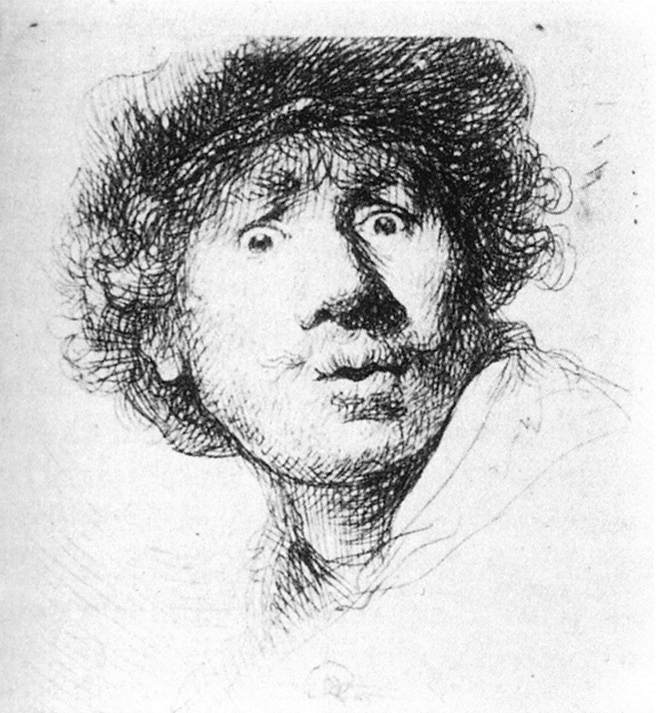
Rembrandt, Self-Portrait in a Cap, Open-Mouthed, 1630, etching


Art was one of those classes I took to offset my load of “real” course work. The teacher was straight out of the textbook.  Perhaps my memory is tainted, but he really did look like Van Gogh, minus the bandaged ear.  He was a quirky, melancholy, disheveled man who became highly animated when he talked about artwork.  I don’t remember much from class other than sketching leaves, a tennis shoe, and shadowed 3-dimensional blocks.  The most lasting instruction I received from Van Gogh was:  “Don’t ever say that a painting is pretty.”  The humble beginnings of my art appreciation education.

One of the perks of our homeschooling lifestyle is the freedom, flexibility, and capacity to step out of the mainstream pace of life and delve deeply into whatever we’re studying.  We’ve begun a (one-sided) relationship with Rembrandt Van Rijn.  As with any relationship, we’re in the early stages of turning over various pieces of the puzzle of his life and artwork, and studying them individually.  Each gives a glimpse of the larger, finished project.  As a side note, I’m struck that even if we had lived down the street from him, shared dinners and holidays, and had the ability to talk with him over a hot cup of Dutch koffie, we’d still limited in how well we could know him.  That’s just the way we’re created – as a bottomless box of puzzle pieces.  No matter how many are plucked out, studied, and meticulously rearranged, only the Creator has the vision to see us in our entirety.  I find it somewhat humorous that we think we have each other “figured out.”

But back to Rembrandt… One of the puzzle pieces we’ve pulled out of the box is his uncanny use of light and shadow.  Another is his tendency to buck the convention of the time when painting groups of people.  Rather than paint a series of portraits all on the same canvas, he created a storyline of characters.  His paintings evoke emotion and questions:  “What were they talking about?”  “Who was the man in the shadows?”  “What was she feeling?”  The famous Night Watch was one of those controversial paintings in which Rembrandt created a compelling scene rather than a string of flat portraits.  Not all of his subjects were pleased. Some actually demanded their money back.

Personally, one of the most compelling pieces of the Rembrandt puzzle has been his remarkable insight into human emotion.  His paintings draw you to the souls of the subject.  This unique characteristic of his artwork leaves us with an obvious question:  How did he know so much about the nature of people?

In the 50 years of Rembrandt’s career, he produced more than 90 self-portraits.  He became a student of himself  - not only studying the detail of his physical being, but also exploring the complexities and diversity of human emotion. His discovery of self was not rooted in self-absorption.  Artists who were narcissistic tended to paint themselves repeatedly in their best form.  Rembrandt, however, exposed his heart as both kind and enraged, his mind as both theatrical and analytical, and his disposition as both carefree and pensive.  He used self-study as a tool to gain insight into the full range of the human condition.  And the result was his remarkable ability to capture an extensive range emotional and psychological aspects on canvas.  He deliberately explored and discovered self for the purpose of gaining in-depth insight into others.

So what lesson can we learn from the master?

We live in a society that has written reams of self-help books, booming syndication of Dr. Phil and Oprah, and promises fulfillment if only you can identify and achieve  whatever it is that makes you happy.  Self-examination and self-help are in vogue.  However, I’d argue that the motivation and methodology behind most of today's approaches to self-exploration differ greatly from Rembrandt’s.  And from the Master’s as well.

How can you say to your brother, “Let me take the speck out of your eye,” when all the time there is a plank in your own eye?  You hypocrite, first take the plank out of your own eye, and then you will see clearly to remove the speck from your brother’s eye. Matthew 7:4-5

Having an accurate self-assessment is one of the first steps to loving others well.  We all have some form of plank that blocks our view.  The plank can take the form of arrogance or shame. It can masquerade as intellect, discernment, religion, or volunteer service.  It’s anything that distorts the Truth of who we are,  and it in turn distorts our view of others.  If we’re willing to acknowledge the plank, then to have it removed bit by bit, the process is painful yet the result is freeing.  I’ve shared a bit of my own journey here, and I hope to continue undergoing the process of log-extraction as long as I have breath. Although there will always be remnants of the log this side of heaven, our eyesight can be greatly restored.  As we begin to see more clearly, we are enabled to love others in a way that more closely resembles the love of the Father.  In short, we can begin to get ourselves out the way, and let Him love others through us.  


An unsolicited, unpaid-for, no kick-back, but straight-from-the-heart advertisement:  


For those of you who live in Charlotte and would like to spend some focused energy on the art of walking through life with others, I’d highly recommend your consideration of Barnabas Training.   This powerful approach utilizes reading, writing, group and individual discussions to help us discover "the log in our own eye" so that we are better equipped to see more clearly and love others well.

Thursday, August 18, 2011

Top Ten Reasons We're Excited for School


Tis the season for back-to-school shopping, planning, paperwork, and a return to a more scheduled life.  Even the non-list makers (like me) are making lists to ensure that everything gets done.  I for one, love the fall.  For me, it signifies a fresh start to a year full of possibilities.  This morning, as we were discussing the next few weeks together, I commented that I was full of anticipation and excitement for this year in particular.  My son said, "Mom, you always say that."


Well, yes I do.  And in the spirit of list making, here are few things that I'm most excited about as we launch off into a new school year:


10.  Great Read-Alouds - Our time reading great books together will always be a cornerstone of our schooling.  I love the smell, feel, and pictures in the books, and I love the sound of my children begging for "just one more chapter,"  the conversation that bubbles up as a result of our reading, and the richness that is added to our family culture.  We have a long list of books on the docket, most of which are "living books."  I look forward to meeting new friends, experiencing different cultures, and having a front row seat as major historical events unfold - all while cuddled together on the couch.  


9.  First Lego League - Brings to mind images of happy, carefree children building towers with boxes of brightly-colored legos.  Not quite.  This year, Will (my newly 12 yr old) is participating in the FLL.  Think intricately-built robots, student-designed computer programs to direct the robots, team building, problem solving, public speaking, with the culmination being a competition with other groups in the state.  Given his talents and interests, the FLL has given him a place to explore and grow, and has been welcome addition to our school year.


8.  Community Bible Study (CBS)- We'll be studying the gospel of Luke this year.  Ya can't go wrong there!  I'm grateful that not only the children and I will be studying the same thing, but that David's evening class will be as well.  "Education without values, useful as it is, seems rather to make man a more clever devil."  C.S. Lewis


7.  Fun Fridays - I learned last year that we do much better if we arrange our week so that we spend Monday-Wednesday on our core classes (math, writing, languages, etc.), CBS on Thursday, then reserve Friday for Science.  Last year, we studied birds, including participating in the Cornell Dept. of Ornithology bird count study.  This year, we're studying plants.  I know nothing.  Hopefully I'll know more by the end of the year.  We start Friday mornings on the porch reading about the topic for the day, then spend much of the rest of the day doing an experiment, nature walk on the greenway, or painting/drawing whatever we learned about.  Fridays often entail field trips to the museum, a play, the library, or adventures with friends.


6.  Music - I love our home being filled with beautiful music.  With 3 children practicing piano, one playing the guitar, and the youngest (and possibly her mother as well) adding violin to the list of instruments being practiced, I'd estimate that we have 2-3 hours of music screeching, banging flowing from our home everyday.


5.  Writing/Art/Latin - We have been lavished upon greatly with wonderful teachers who speak into the lives of my children.  I'm forever grateful for their technical expertise, passion, individual gifting, and their unequivocal dedication to and love for the kiddos.  And I'm a lucky duck because I get to see them every week.


4.  Training for a 5K - For the first time, we'll be training as a family to run a 5K together.  The schedule started this weekend, and we'll be running 3 days during the week and once on the weekend in preparation for the race this fall.  I look forward to their experiencing the discipline, persistence, commitment, and reward of support from each other as we gasp breeze through the miles.


3.  Philadelphia - We use a classical approach to studying history, which basically means that  we take all of history and divide it into 4 years, to be repeated after the 4th year.  We covered Ancients, then Medieval, Renaissance, and now we're coming up on the Explorers/American history.  So, we're off to see the Liberty Bell, the National Constitution Center, Independence Hall, and no doubt a few famous Philly cheese steaks in October.  And by the way, we'll just so happen to be able to catch the Andrew Peterson/ Steven Curtis Chapman concert in PA on the way.  Our trips to experience whatever we've been studying continue to be one of my favorite dimensions to our schooling.


2.  Rembrandt - This year, we have a fabulous line-up of resources from which to study the life and works of Rembrandt.  As I was plotting our our trip to PA, I was thrilled to discover that the Philadelphia Museum of Art would be hosting "Rembrandt:  The Faces of Jesus" during our trip.  Rembrandt's 7 paintings of  Jesus will be reunited for the first time since 1656.  In posing an ethnographically correct (Jewish) model and using a human face to depict Jesus, Rembrandt revolutionized the history of Christian art. We started reading The Night Watch:  Adventures with Rembrandt and enjoying his artwork this week.  We're warming up to becoming friends.  I can hardly wait.


1.  Margin - I don't take for granted the privilege and responsibility that I have in tailoring my children's education.  Through the years, I've become convinced that the best part of what we do can never be measured by a year-end test.  I try to apply the general principles of "do what's most important first," then make plans around those priorities.  We've cut out some activities this year hoping to create more margin... To serve our refugee friends.  To be more available to others.  To have leisurely conversations about life, art, the Panthers, and whatever else is on our minds.  To play in the creek.  To read for pleasure.  To stop and watch the spider miraculously spinning her web or the weary yet determined ant carry the crumb to her home. To learn to be still.


As you venture into your school year, please join me by reviewing your own lists.  Do they support your long-term priorities?   Are you considering making changes to help your practical-everyday life line up more closely with your this-is-what-I-value-most life? I'd love to hear more.  Best wishes, and a "Happy New Year" to you and yours!

Thursday, August 11, 2011

Full Disclosure


This is a disclaimer:
If you've read any of my posts about books,  I feel that in good conscience (wink), I should let you know: I’m not an English scholar, I’m not an author, and my resume doesn't include teaching as a previous occupation.  The only authority from which I speak is one of my own experience...

So why the time and energy given to discussion about books? 


Here’s a snippet of my story:

I’ve been a lover of literature since high school.  For my 15th birthday, my dad bought me The Complete Poems of Emily Dickinson.  For my 16th, The Complete Poems and Plays of T.S. Eliot.  My high school literature teacher allowed us to dissect and discuss U2 songs as an introduction to poetry.  The spark was ignited.  I was mesmerized by the alchemy that occurred through taking individual, common words, and rearranging them in such a way as to create something much more powerful than the sum of themselves. 

In college, if I had had my “druthers,”  I would have majored in English or Philosophy.  But I came from a pragmatic home, and a degree in Business was a much more practical choice.  No complaints – I ended up with a (wonderful) career in corporate America, but my love of literature laid semi-dormant for another season of life. 

When the decision was made to homeschool our younger children, I became immersed in a new sub-culture.  As with any sub-culture, there was both good and bad, but the good was really good.  During our first year of schooling, I attended a large homeschool conference and book fair with a dear friend.  We stumbled upon Jan Bloom’s booth, which held thousands of beautiful old books for sale.   Hearts beat faster as we feverishly plundered through the shelves in search of hidden treasures waiting to be claimed. Jan had written a book on books, and was an alchemist in her own right.  She would talk about each book as if it were her own child.  As she carefully took each one off of the shelf (“held be center of the spine, not top, which could do damage”), she would chronicle the history of the author and the list of its sibling books.  With a twinkle in her eye, Jan ushered us into each story, introduced us to the characters, and prepared us for the adventure on which we would be taken.  Within a span of minutes, I had experienced the heart of C.S. Lewis’s observation of friendship:

Friendship is born at that moment when one person says to another: 
"What! You too? I thought I was the only one."

My love of literature was aroused from years of hibernation.  Yet this time, I was not alone.  My friend and I continued to learn about, revel in, and search for great books.  Book fairs, library sales, and an occasional antique mall produced well-stocked home libraries.  We were fortunate enough to bring speakers like Jan Bloom, Sally Clarkson, and Sarah Clarkson to Charlotte.  These women poured into our lives, and the lives of our friends and children.  The culture and substance our children’s childhoods have been indelibly altered as a result.

To whom much is given, much is required.  I’m acutely aware that I’ve been entrusted with a treasure of great value.  In the months to come, I will occasionally be including among my posts some thoughts, observations, and suggestions of books for both adults and children.  I'd like to thank you in advance for graciously overlooking inevitable mixed metaphors, occasional apostrophe errors, and accidental misplaced modifiers.  I also want to be upfront in letting you know that few of the thoughts contained in those upcoming posts are uniquely mine.  They are a melding of the teachings of others.  My hope is that the ideas, resources and experiences that I share are added to your own.  And from those primary elements, the Great Alchemist can transform the common into the extraordinary.


Saturday, July 23, 2011

Books for Boys: Why it Matters


Boys.  Wow.  They’re different.  Having grown up in an estrogen-rich home with only one sister, I had a limited understanding of just how diverse the differences between boys and girls were.  As a college student, I was stunned to see one of our male neighbors (we’ll call him “Hamilton”) drink directly from a carton of milk.  Who ever thought of doing such a thing?  I was shocked not only by the action, but also by my naivete.  At the wise old age of 20, I apparently had a few things left to learn about the opposite sex.

When I married my husband, with him came Chapman, a charming blue-eyed little boy.  This life change resulted in my immediate enrollment in “Boys 101.”  No more auditing.  This was the real class.  One of my earliest "boy" memories was created within the first few months of marriage. I was happily lost in the world of my latest book, when a sudden noise jarred me back to reality.  It became repetitious.  It was getting louder.  In the corner of the family room, lounging happily on the floor, was was a very content 4-yr-old Chapman. He had his matchbox cars lined up neatly in two rows.  Every few minutes, after they had completed the requisite figure 8’s, one car from each of the rows would collide with great velocity into the another.  Each crash came with impressively accurate sound effects.  Mystery of said noise solved.  I leaned over and asked what I thought was a reasonable question.  “Could you please be a little bit quieter when you do that?”  He gave me a look that I will never forget.  It communicated something close to, “And what would be the point of that?” Hamilton’s milk carton sprang to mind.  Boys.

Yes, boys are different than girls in a variety of ways.  Unfortunately, the literacy rate for boys falling consistently behind that of girls is one of them.  No doubt, there are a variety of factors that contribute to the problem, yet there is a consistent common denominator among researchers:  boys read far less than do girls.

Why aren't our boys interested in reading? 

“Boys prefer adventure tales, war, sports and historical nonfiction, while girls prefer stories about personal relationships and fantasy. Moreover, when given choices, boys do not choose stories that feature girls, while girls frequently select stories that appeal to boys. Unfortunately, the textbooks and literature assigned in the elementary grades do not reflect the dispositions of male students. Few strong and active male role models can be found as lead characters. Gone are the inspiring biographies of the most important American presidents, inventors, scientists and entrepreneurs. No military valor, no high adventure. On the other hand, stories about adventurous and brave women abound. Publishers seem to be more interested in avoiding "masculine" perspectives or "stereotypes" than in getting boys to like what they are assigned to read.”  Why Johnny Won’t Read (The Washington Post)

So what’s the response?  


We want our boys to want to read.  Unfortunately, many publishers have attempted to solve the problem by “insisting that we must "meet them where they are"—that is, pander to boys' untutored tastes.  For elementary- and middle-school boys, that means "books that exploit [their] love of bodily functions and gross-out humor." AP reported that one school librarian treats her pupils to "grossology" parties. "Just get 'em reading," she counsels cheerily. "Worry about what they're reading later."  How to Raise Boys Who Read (Wall Street Journal)
One of the many problems with this approach is that the end-goal is rarely reached.  Boys’ hearts and minds hunger for stories of substance. We spoil their appetite by providing them with a steady diet of intellectual junk-food.  The “at least they’re reading” theory is a bad one.  In dumbing down the books that we give our boys, we’re reinforcing destructive messages about reading, quality literature, and the intellectual capacity of our young men.
But as it is with all appetites, we must be intentional in helping a healthy one develop.    How?
~Be intentional. Have a standard and a plan - for books to purchase and for books from the library.  For each of my children, I've created a simple spreadsheet with a list of books that I would like them to read AND that I think they'd enjoy.  This makes the quick trip to the library or the Christmas list for Grandma an efficient, pain-free way to obtain quality books for them.  Visit the Exceptional Resources for Children’s Books page.  Each book listed is filled with great recommendations.
~Put reasonable limits on “distractions”  - all screen time.  When left to our own propensities, we often gravitate toward that which requires less work.  Reading is deeply rewarding, but it requires more work than do video games and the TV.  The studies correlating literacy with screen time are staggering. 
~Listen to their interests and look for books that would be engaging to them. One of my sons judges the quality of a book by the number of battles that occur within.  His first literary love was the Dan Frontier series (Frontiersman and Indians).  Then came Peter Pan battling Captain Hook, Robin Hood, and King Arthur.  He's also, shall we say, addicted to engaged in  all things Star Wars.  Although I might not deem the Star Wars books as great literature, they do embody great story. 


Battle boy's brother has a keen sense of humor and is drawn to books that are clever.  To name a few, he's been absorbed in Edith Nesbit's Complete Book of Dragons,  Jonathan Roger's The Wilderking Trilogy, and most recently, GK Chesterton's Father Brown stories.  The Chronicles of Narnia and Andrew Peterson's Wingfeather Saga are forever woven into the tapestry of both of their childhoods.  Although we try to provide a “well-rounded meal” of different genres of literature, I always defer to their tastes when purchasing books for gifts or rewards.
~Read aloud.  And for the biggest benefit, have Dad read aloud.  Consistently.  My husband, who is not necessarily a read-for-pleasure guy, has committed to read aloud to the boys at night before they go to bed.  I do the research and supply the “boy books.”  They’ve worked their way through most of the Ralph Moody Little Britches series, and the three of them have developed a “secret culture” of which I’m (happily) not a part. The characters have become their friends, and they now have a long list of escapades and adventures which they have experienced together.  They’ve learned to love story.
~Appreciate boys for who they’ve been created to be.  Have vision for who they can become.  Look for books that affirm and inspire them.  Look for books that delight the imagination.  Begin with “the end” in mind.  If you want young men who are thoughtful, intelligent, compassionate, brave, and of high character, give them a steady diet of books that will shape their souls in that direction.


"More than the painting you see or the music you hear, the words you read become in the very act of reading them part of who you are, especially if they are the words of exceptionally promising writers.  If there is poison in the words, you are poisoned;  if there is nourishment, you are nourished;  if there is beauty, you are made a little more beautiful.  In Hebrew, the word dabar means both word and also deed.  A word doesn't merely say something, it does something.  It brings something into being."  Frederick Buechner
When you have a few moments, listen to this song by Steve Taylor (you'll have to listen beyond the very 80's synthesizer).  At its very heart is the power of the Greatest Story.  


For our boys…

When the house fell asleep

There was always a light

And it fell from the page to the eyes

Of an American boy

In a storybook land

I could dream what I read

When it went to my head I'd see

I wanna be a hero

But the practical side

Said the question was still

When you grow up what will you be?

I wanna be a hero

Hero

It's a nice-boy notion that the real world's gonna destroy

You know

It's a Marvel comic book Saturday matinee fairytale, boy
Growing older you'll find

That illusions are bought

And the idol you thought you'd be

Was just another zero
I wanna be a hero

Heroes died when the squealers bought 'em off

Died when the dealers got 'em off

Welcome to the "in it for the money as an idol" show

When they ain't as big as life

When they ditch their second wife

Where's the boy to go?

Gotta be a hero
It's a nice-boy notion that the real world's gonna destroy

You know

It's a Marvel comic book 
Saturday matinee fairytale, boy


When the house fell asleep

From a book I was led

To a light that I never knew

I wanna be your hero

And he spoke to my heart

From the moment I prayed

Here's a pattern I made for you

I wanna be your hero


****************************************************
My Heroes...