Showing posts with label Stories. Show all posts

Wednesday, November 23, 2011

The Twelve Books of Christmas

Well, apparently it's book month.  I didn't plan it that way, but after weeks of illness, perhaps gushing over my favorite books requires the least amount of energy and provides the most therapeutic joy.  Oh, and I also wanted to get some book ideas out there prior to advent and the start the Christmas gift buying season.


~~~~~~~~~~


A highlight of our advent season is the unpacking of our box of beautiful Christmas books.  They, like our favorite ornaments, embody the ghosts of Christmases past.  Each holds a dear memory - curling up by the fire with hot chocolate in hand, the twinkle of Christmas tree lights dappling the ceiling, babes in footed fleece pjs cuddling on mommy, or the "remember whens" represented by many of the vacation-purchased ornaments.  Out of that box of books, we unpack love, anticipation, excitement and tradition, and every year, we look forward to carefully choosing and adding a new addition or two.  


A few years ago, we began a new Christmas tradition.  The kiddos open their sleepy eyes Christmas morning to find a small stack of books sitting at the foot of their beds.  The day starts peacefully, as they enjoy exploring the newest additions to their libraries.  Mom and Dad also happen to benefit from a little more sleep before the present-opening festivities begin.  We do love our books!


Here are a few of our favorite Christmas books, and two new ones we'll be adding to the family:


12.  We're looking forward to receiving a copy of Russ Ramsey's new book Behold the Lamb of God.  For those of you who are familiar with Andrew Peterson's Behold the Lamb of God Christmas concerts, this is written with the same heartbeat.
"When Andrew Peterson sings 'Behold the Lamb,' three worlds collide:  ours, Abraham's and Jesus'.  Russ Ramsey's book opens the doors between those worlds and helps us bring them together."  Michael Card
Behold the Lamb of God can be used either for personal reflection or as a family devotional during advent.  The jury is out regarding the book's inaugural use in our home (I may selfishly monopolize this first year),  but I look forward to incorporating it into our annual Christmas reading list.


If you would like to download a free preview of Behold the Lamb of God or place an order, you can visit here.  There is also an option to bundle the book along with the CD, which makes a great Christmas present for those who are unfamiliar with Andrew Peterson's music.  You really can't go wrong with an amazing songwriter (Peterson) and a fellow-appreciator of Rembrandt (Ramsey).  

11.  If you have young ones in your life, you won't want to miss Sally Lloyd-Jones' new picture book Song of the Stars.  Our copy is in the mail, so I can't yet testify as to its beauty and warmth; however, I have the fullest confidence that I will soon be able to do so.  
"The Psalms tell us that the created order now declares the glory of God (Psalm 19 and 65) and then when Jesus returns even the trees will sing for Joy (Psalm 96).  How fitting, then, to imagine the animals and stars sensing and rejoicing in the coming of Christ for the first time.  This is a lovely book!"  Tim Keller


Perfect for young ones, or those who are young at heart.  You can purchase Song of the Stars here.


10.  A few years ago, a dear friend loaned a copy of Jotham's Journey to us for use during advent, and I was not prepared for the significant impact that reading it would have on our family.  Jotham's Journey is the first of a trilogy in which Arnold Yuletide weaves together the story of a young boy, his friends and their adventures leading up to the birth of Christ.  In reading these books, we're able to pull away from the hectic pace and distraction of our society in order to stop and consider the world into which Jesus was born.  A world ruled by the Roman Empire, a world of oppression, a world of political domination, a world of slavery... a world in need of a Savior.  Far from the typical peaceful manger scenes found in many children's books, Jotham's Journey  is rich in suspense, danger, anticipation, and confusion around the events that take place.


Each of the three books ( Jotham's Journey, Tabitha's Travels and Bartholomew's Passage) represents the viewpoint of one of the three friends, and the books don't necessarily need to be read in a particular order.  We read one each year, and I'm amazed by the corroborating details that the children remember from prior years.  Each chapter is to be read on a given day during advent and has a short devotional at it's end.  Given the intense nature of the political and social climate, I wouldn't recommend that they be read to children younger than elementary age.  There is enough substance and depth that these books would easily be enjoyed and appreciated by those without children in the home.  


You can order Jotham's Journey or its sibling books here.


9. The Birds' Christmas Carol is a heart-warming story about a little girl, who although sick and bedridden, embodies gratefulness and unselfishness as she plans a Christmas celebration for a needy neighboring family.  Written and published in 1887, this book whisks the reader back to the Victorian era, yet the love, compassion, and humorous family dynamics shared are timeless.


*You can download The Birds' Christmas Carol for free at gutenberg.org


8.  The Christmas Stories of George MacDonald.  How can you go wrong...


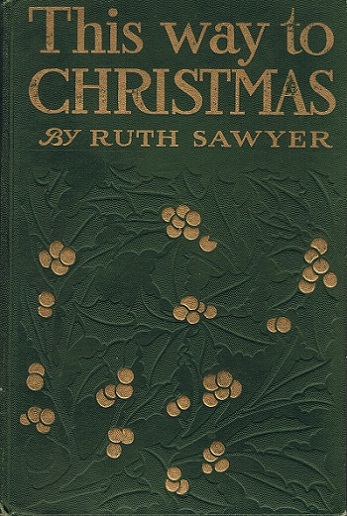
7.  We recently discovered This Way to Christmas by Ruth Sawyer.  In this delightful folktale, a young boy is sent away to live on a lonely mountain during the war.  As he gradually befriends his neighbors, he hears their tales of Christmas celebrations from other cultures.  I'd recommend that this book be read aloud, as there are a few sections which deal with prejudice, and some of the terminology merits discussing (or avoiding if you're reading with young children).  As one would expect, all ends well as the diverse, superstitious, isolated neighbors discover and enjoy community.


6.  Plum Pudding for Christmas by Virginia Kahl is pure fun.  True to her other books, it is written in rhyme, and is delightfully witty.  The king is away, and all chaos breaks loose when one of his many daughters eats the last plum in the kingdom.  How will a fitting Christmas celebration be possible?  Although out of print, it's fairly easy to find on Amazon, ebay, or addall.com.


5.  Christmas Day in the Morning by Pearl Buck is probably the least-known yet has become one of my most-loved books among the list.  This simple picture book depicts an unspoken, yet deeply felt love between a father and a son. The young boy makes a selfless choice in order to show his father the depth of his appreciation, and they are both blessed deeply as a result.  Life is found when one lays down his own comfort on behalf of another.  I cry every time I read it out loud.  


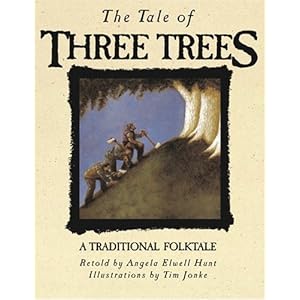
4.  A Tale of Three Trees reminds us that God's plan often differs from our own expectations and dreams - yet it is always best.  A beautifully-illustrated book that can (and should) be read during both the Christmas and Easter seasons.

3.  The Jesse Tree by Geraldine McCaughrean is ideal for children of elementary age through adults, and can be used as a family or personal devotional during advent.  As an old man whittles away at creating a Jesse Tree for his church, each symbol carved introduces a story from the lineage of Jesus.  We are reminded that all of history, beginning in the Garden of Eden, was in preparation for the One who would come to save us.  


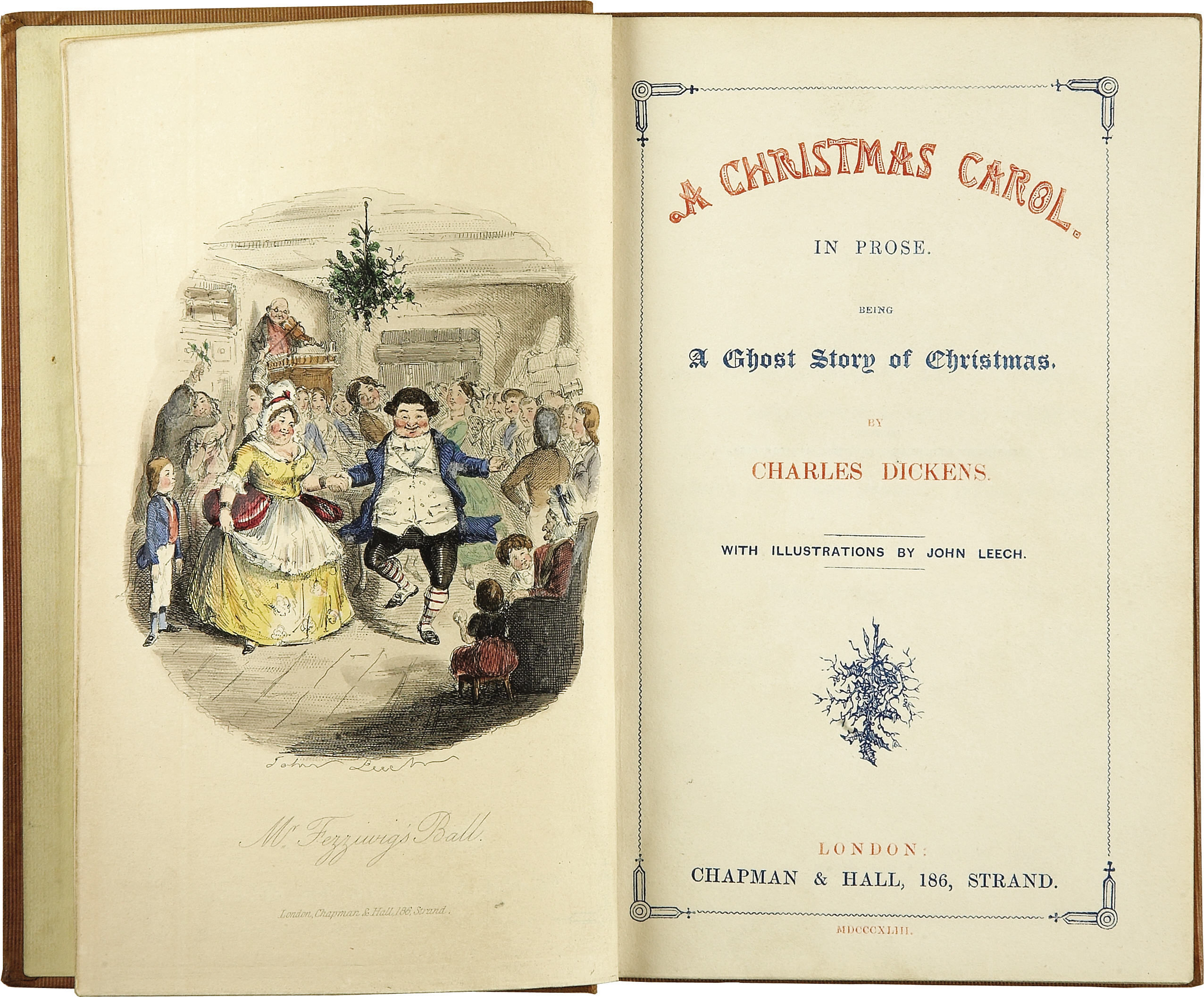
2.  A Christmas Carol by Charles Dickens.  It just gets better through the years.


*You can download A Christmas Carol for free at gutenberg.org

1.  The Year of the Perfect Christmas Tree by Gloria Houston will forever be one of our "staple" Christmas books.  It's simple, sweet story about an Appalachian family which is preparing for Christmas while at the same time longing for the father, who has yet to return from the war.  It's a story of hope, family, faith, perseverance, and Christmas miracles.


Wow.  That was harder than I thought it would be.  I feel compelled to console the books that didn't make the list by assuring them they'll be included next year.  Hmmm.  

If you're a lover of books, I hope that you've found something new to add to your collection.  If you're not, I'd invite you to discover a new treasure to add to your Christmas memories.

~~~~~~~~~~

During a season that is marked by food prepared to delight the palate, decorations hung to please the eye, and music played to bring joy the ear, it seems fitting that we carefully choose and read books which will nurture the soul.

Wednesday, November 9, 2011

First of the Foundational Five: The Bible

This is the first of what will eventually be five postings on foundational genres of literature for children.  More on the backdrop for those discussions here.


~~~~~~~~~~


During our children's early years, we have the great privilege of introducing the world to them, bit by bit.  As we begin exploring the literature that shapes the minds and souls of our young ones, we'll start at the very beginning... with the book that introduces the great themes found in all literature...  with the most published and widely read book of all time - the Bible.


There is an increasing acknowledgement, even in secular circles, that Biblical literacy is an important part of a well-rounded education. "The Bible's influence is impossible to ignore. There are more than a thousand Biblical references in the works of Shakespeare alone. John Milton, Herman Melville, Ernest Hemingway, all drew on the Bible, too.  Then there's Rembrandt, Chagall, da Vinci, who all put the Bible on canvas.  Even the Declaration of Independence alludes to the Bible." The Bible as Literature (CBS News). 


In addition to classical literature, Biblical references are plentiful in pop culture as well.   Leonard Cohen's ballad "Hallelujah," which has been performed by Justin Timberlake on an MTV telethon and K.D. Lang during the 2010 Olympics opening ceremonies, weaves together allusions to King David and Bathsheba as well as Samson and Delilah.   Virtually all aspects of our culture - sports, politics, movies, television, popular literature - are influenced to varying degrees by the Bible.


Well-written stories provide insight into the answers of life's fundamental questions such as "Who is God?" and "Who is man?" You can't get much more foundational than that.  Our views of the world, ourselves, and others are shaped by what we believe to be the answers to those questions.  The Bible answers virtually all of the "big" questions in life - even if the answer is to have faith in that which we do not fully understand.  


Currently, we live in a country where we have endless choices from which we can select children's Bibles.  A search for "children's Bibles" on Amazon.com, for example, yields over 31,000 results.  How do we begin to narrow down the plethora of choices? 


Here's a start:


For those who are young or old, those with no Bible knowledge or those who have seminary degrees, I highly recommend The Jesus Storybook Bible (JSBB) by Sally Lloyd-Jones.  This is far from your typical storybook Bible.  Here’s a window into its uniqueness:

“No, the Bible isn’t a book of rules, or a book of heroes.  The Bible is most of all a Story.  It’s an adventure story about a young Hero who comes from a far country to win back his lost treasure.  It’s a love story about a brave Prince who leaves his palace, his throne – everything – to rescue the one he loves.   It’s like the most wonderful of fairy tales that has come true in real life!  You see, the best thing about this Story is – it’s true.  There are lots of stories in the Bible, but all the stories are telling one Big Story.  The Story of how God loves his children and comes to rescue them.”

With that as the setting for the greatest of love stories, Sally Lloyd-Jones takes complex theological truths and distills them to their simplest form.  Her approach to writing is based on the premise that “Nothing but excellence should be the standard for children.  The quality of literature should be higher (than that for adults) because the responsibility is greater… A story that takes children seriously uses rich language that invites imagination.”

Throughout the Jesus Storybook Bible, we’re invited into The Great Story through rich language, vivid illustrations, and profound Biblical truth.  Perhaps the most distinctive characteristic of the JSBB is the way in which Sally Lloyd-Jones masterfully, consistently weaves the heart of the Great Story, the Father coming back for his children, throughout each of the Old Testament stories.  The power and uniqueness of the JSBB are authenticated by the depth and breadth of the ways it is currently being used:

~THEOLOGIANS using it as their Bible study text
~JAPANESE BUSINESS men studying it before work
~CHINESE PROSTITUTES as part of their healing process
~PUBLIC SHOOLS after-school programs in Alabama public schools
~PASTORS using it to help them preach
~ELDERLY PEOPLE reading it in retirement homes
~LITERATURE classes using it as a set text (Calvin College)
~COUPLES using it for their devotions together
~EVANGELISM initiatives using it to introduce Jesus to different faith communities
~COLLEGE STUDENTS using it as their Bible study text
~FOOTNOTES in theological books referencing it


I had the great pleasure of meeting Sally Lloyd-Jones several weeks ago.  Her inscription in our family JSSB speaks to the heart of the gospel:

  "To the Silander Family - This story is for you." 

 And it's for YOU. 

 And it's for ALL.

For more information on JSSB, including video clips, free audio downloads, and ordering information, visit here.
~~~~~~~~~~~

Another resource that has become a staple in our home library is the The Child's Story Bible (CSB) by Catherine F. Vos.  The book was a result of her search for a Biblically accurate children's Bible when her children were young.  After finding only watered-down versions of Bible stories, Vos began writing with the goal of  producing a theologically-correct, yet accessible depiction of the Bible for her own children.  Her vision, however, took longer than expected.  The Children's Story Bible was not completed until she was a grandmother. 


You could view the CSB as an intermediate version of the JSBB.  Similarly to Sally Lloyd-Jones, Catherine Vos weaves the ultimate theme of the Bible throughout her recounting of the individual stories.  She takes a chronological approach to her telling of Biblical events by grafting complimentary stories from related Biblical passages, and consolidating them into topical chapters.  For example, the Chapter "The End of the Kingdom of Israel" pulls content from II Kings 16,17 and II Chronicles 28.  The chapter "Jesus' Last Word to His Disciples" assimilates corresponding passages from all four gospels.   


After years of attending in-depth Biblical studies, it was not until I read the CSB with my children that I experienced "a-ha" moments in piecing together individual stories in the Bible.  It reads like a novel, and succeeds in giving an accurate, comprehensive picture of Biblical history.
~~~~~~~~~~

Our young ones have also enjoyed the Read Aloud Bible Stories by Ella K. Lindvall.  There are four volumes in the series, as well as the Parables Jesus Told:  Tell Me Stories.  Each volume contains five stories from the Bible which are written in large print, telling in sing-song fashion the fundamental truths of each story.   Written for pre-schoolers, the narrative paints a picture of the scene and invites the listener to step in and experience the action.  


The simplicity and directness of these stories speaks powerful truths to the old and young alike.  They are a wonderful addition to the resources mentioned above, and are perfect for new readers who want to read from "their own" Bible.
~~~~~~~~~~

There is no greater gift that we can give our children than a winsome invitation into the life-long love story written by the Author of all Hope. 


Saturday, October 1, 2011

Along the Road - Hutchmoot 2011

I'm a lover of life.  A glass-is-half-full girl.  A believer in ideals.  But life can be really, really hard.  And if it's not hard for me at the moment, chances are, it is for one (or many) of those close to me.  Over time, I've had the honor of walking with folks who were navigating through some treacherous territory.  They didn't see it coming, and weren't sure they'd be able to find the way out.  I've been there a time or two.  And I bet, so have you.  Thank goodness we're all here to stumble, sprint, roam, crawl, dance, climb, skip, limp and wade through life together.

In returning from my weekend at Hutchmoot, I've been pondering how and what to report back to those who've graciously shown interest.  This is my attempt.  For starters, it may be helpful to address the etymology of the name.  

Hutch - n.  A coop for the housing of small animals, especially rabbits.  
Moot - n.  An ancient English meeting, especially a meeting of the free men of a shire.  v. To discuss

Hutchmoot is the convening of 100ish music, art, Lewis and Tolkien-loving folks, many who have met virtually in the Rabbit Room. Hutchmoot is more of a family gathering than a conference.  It offers community rather than instruction.  Its intent is to inspire and enjoy rather than to equip.  

Upon returning from my weekend away, our family resumed reading Dangerous Journey, which is a beautifully illustrated retelling of Pilgrim's Progress. The story begins by introducing Christian, who carries a heavy burden upon his back.  He works with it.  He sleeps with it.  He can find no relief.  In an effort escape from certain doom, Christian embarks upon an odyssey of discovery that leads him through great peril, uncertainty, and pivotal  choices.  During his travels, he meets a variety of fellow-travelers.  Some of them, such as Obstinate, Pliable, Worldly Wiseman and Mr. Legality offer a plethora of counsel to Christian.  Their counsel, however, is unhelpful at best and near-fatal at worst.


One broad road turned to the left;  another broad road turned to the right;  while the narrow road went straight on - up the great black back of the Hill called difficulty.  Which one would they choose?  Formalist chose to go to the left, which led him into a dark wood.  Did he but know it, the road was call Danger, and he lost his way for ever.  Hypocrisy chose to go to the right, which led him into rough ground, full of holes and hummocks.  Did he but know it, the road was called Destruction.  Here he stumbled and fell, and rose no more.  As for Christian, he paused and drank at a spring to refresh himself.  Then after looking both ways, he started briskly straight up the hill.

Others join Christian and impact his journey in quite a different way.  Evangelist points him in the right direction.  The Interpreter helps him gain understanding.  Faithful, who has fought quite different battles from those Christian experienced, offers encouragement and fellowship along the way.

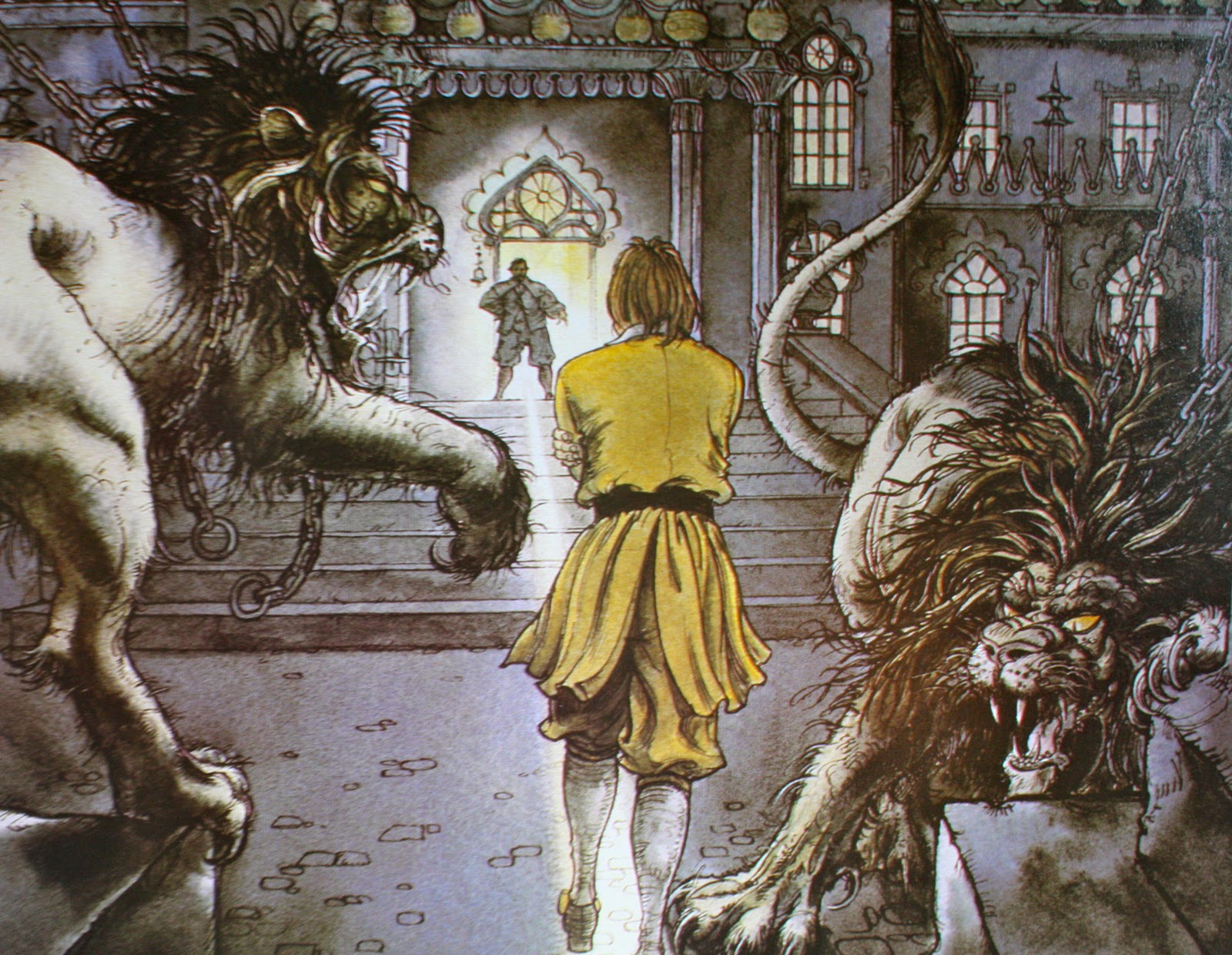
So I saw in my dream that he made great haste.  But as he drew nearer, he could hear in the darkness the roaring of the lions.  The only way forward was along a narrow passage, which was about a furlong from the porter's lodge.  This, he knew, was the place from which Mistrust and Timorous had fled.  And Christian was never so near to running back after them.  But the porter at the lodge, whose name was Watchful, perceiving now that Christian made a halt, cried out:   "Is your strength so small?  Fear not the lions.  They are on long chains.  If you keep strictly to the beam of light, in the center of the path, they cannot reach you."  So Christian moved on.  He took good heed to the directions of the porter.  At the same time, he trembled for fear of the lions, for now they were on either side of him, straining at their chains.  And how they roared, and snapped at him!  And how they tried to catch him by the foot!

Although the characters are prototypical, I can see myself in each on any given day.  At times, I offer hope, encouragement and companionship to those who are struggling.  At others, I'm presumptuous, hypocritical, timid, and not particularly helpful in encouraging my fellow-travelers to persist and press on in the right direction.  As the years go by, my hope is to become a better travel companion.

My time in Nashville was a sweet reminder that we're not left alone on this unpredictable journey of life.  Those I met did not have names like Evangelist, Faithful, or Goodwill, yet they gave me great gifts of encouragement, community, and hope.  Here are few glimpses of our encounters along the road:

~ Pete Peterson - Affirmed that just as God created in His own image, we create from our own personal stories.  Although flawed, we are born to create.  That which we create has dignity, and reflects the hope and the truth of the gospel.

~ Jonathan Rogers - Encouraged us to spend time considering our story... those moments, years, and decades in life that make up our personal history.  Within each of our lives can be found the story of redemption.  Not just in the few dramatic, life-altering scenes, yet more often in the details of the mundane.  Pay attention.  Take note.  

~ Ben Shive - Challenged us to look for stories of redemption in unlikely places.  Although that may not have been his end-goal, it was certainly a by-product of his recounting the life and works of Brian Wilson.  Who "woulda thunk"  that his music is complex and innovative, or that redemption can be seen in the story of his life.  Not in a renewal of Wilson's strength and vigor, but in the kindness of those surrounding him when he finally reached the end of his proverbial rope.  Listening to the Beach Boys will never be the same.  And hopefully, neither will listening to the stories of folks whose paths intersect with mine.  I want to listen without presumption, but with anticipation and curiosity.

~ Russ Ramsey and Justin Gerard - Illuminated the connection between the art of the masters and the Master himself.  By becoming apprentices of the great artists - studying their lives, technique, style and artwork, we can gain glimpses of the Kingdom from a new and fresh vantage point.  Gerard, who is an amazing artist and illustrator, conveyed, "I can't write like Tolkien, but I can reflect what he's done with my own art."  There's a sermon or two for us all in that statement alone.

~ Sally Lloyd-Jones - Inspired us to believe in the power of language and story, and to fall more deeply in love with The Great Story.  "A story can do much more than teach, it can transform you.  It works secretly," she shared.  Trust the story to do the work.  Don't feel like we we have to push morals.  I'm still mulling over the implications of that one.  With her humble, winsome, and delightfully British accent, Sally treated us to a lovely storybook time which could have rivaled that of the Darling children in Peter Pan.  She then narrated the story of her own life, complete with a few significant plot twists, compliments of the Author.  She inscribed my daughter's Jesus Storybook Bible with the following, "Caroline, This is your story." And it's mine.  And it's yours, too.

~ Andrew Peterson - Reminded us all to Whom we belong.  We are the beloved.  We are made in His image.  And we create as a response.  He also reminded us that we have not been left to journey through life alone.  The weekend served as a living testimony that the Kingdom is not only in the future - we've been given a taste of it here on earth.  In all of creation.  In music, art, literature, laughter, kindness, compassion, and yes, in each other.

As I continue to distill all that I experienced over the weekend in Nashville, perhaps the most lasting impression that will mark my soul was the gathering of 100 relative strangers, who because of the great love for their Father, became family.  We were given a glimpse of what will take place one day, when we are all finally gathered together "from every nation, from all tribes and peoples and languages"...


A voice cried out: "These pilgrims now are come from the City of Destruction for the love they bear to the King of this place."  So the Gates of Heaven opened to them, and they entered in.  "And," writes Bunyan in his book, "I was able to look in after them, I saw the streets were paved with gold.  And in them walked - with crowns upon their heads - the company of just men made perfect.  And the Bells of the City rang for joy.  For Christian and his fellow had come to their true home."
Amen.


All pictures and quotations are borrowed from Dangerous Journey:  The Story of Pilgrim's Progress William B. Eerdmans Publishing Company


Thursday, August 11, 2011

Full Disclosure


This is a disclaimer:
If you've read any of my posts about books,  I feel that in good conscience (wink), I should let you know: I’m not an English scholar, I’m not an author, and my resume doesn't include teaching as a previous occupation.  The only authority from which I speak is one of my own experience...

So why the time and energy given to discussion about books? 


Here’s a snippet of my story:

I’ve been a lover of literature since high school.  For my 15th birthday, my dad bought me The Complete Poems of Emily Dickinson.  For my 16th, The Complete Poems and Plays of T.S. Eliot.  My high school literature teacher allowed us to dissect and discuss U2 songs as an introduction to poetry.  The spark was ignited.  I was mesmerized by the alchemy that occurred through taking individual, common words, and rearranging them in such a way as to create something much more powerful than the sum of themselves. 

In college, if I had had my “druthers,”  I would have majored in English or Philosophy.  But I came from a pragmatic home, and a degree in Business was a much more practical choice.  No complaints – I ended up with a (wonderful) career in corporate America, but my love of literature laid semi-dormant for another season of life. 

When the decision was made to homeschool our younger children, I became immersed in a new sub-culture.  As with any sub-culture, there was both good and bad, but the good was really good.  During our first year of schooling, I attended a large homeschool conference and book fair with a dear friend.  We stumbled upon Jan Bloom’s booth, which held thousands of beautiful old books for sale.   Hearts beat faster as we feverishly plundered through the shelves in search of hidden treasures waiting to be claimed. Jan had written a book on books, and was an alchemist in her own right.  She would talk about each book as if it were her own child.  As she carefully took each one off of the shelf (“held be center of the spine, not top, which could do damage”), she would chronicle the history of the author and the list of its sibling books.  With a twinkle in her eye, Jan ushered us into each story, introduced us to the characters, and prepared us for the adventure on which we would be taken.  Within a span of minutes, I had experienced the heart of C.S. Lewis’s observation of friendship:

Friendship is born at that moment when one person says to another: 
"What! You too? I thought I was the only one."

My love of literature was aroused from years of hibernation.  Yet this time, I was not alone.  My friend and I continued to learn about, revel in, and search for great books.  Book fairs, library sales, and an occasional antique mall produced well-stocked home libraries.  We were fortunate enough to bring speakers like Jan Bloom, Sally Clarkson, and Sarah Clarkson to Charlotte.  These women poured into our lives, and the lives of our friends and children.  The culture and substance our children’s childhoods have been indelibly altered as a result.

To whom much is given, much is required.  I’m acutely aware that I’ve been entrusted with a treasure of great value.  In the months to come, I will occasionally be including among my posts some thoughts, observations, and suggestions of books for both adults and children.  I'd like to thank you in advance for graciously overlooking inevitable mixed metaphors, occasional apostrophe errors, and accidental misplaced modifiers.  I also want to be upfront in letting you know that few of the thoughts contained in those upcoming posts are uniquely mine.  They are a melding of the teachings of others.  My hope is that the ideas, resources and experiences that I share are added to your own.  And from those primary elements, the Great Alchemist can transform the common into the extraordinary.


Saturday, August 6, 2011

A Good Book is Like a Lemonade Stand


When we moved to Charlotte in 1994, I accepted a job at a large bank as the manager of the Commercial Training Program.  To you non-bankers, it may sound like a stuffy office job.  It was actually great fun.  Not only did I get to participate in hiring the latest crop of college graduates, but they were placed in my care for 12-18 months of training and development.  My charge was to ensure that by the end of that time, they had received all of the coaching, training, information and experience needed to be able to assess the health of a company, negotiate and sell bank products, and manage the entire banking relationship for a portfolio of companies.

I was fortunate enough to partner with a rather progressive consulting company that developed day-long seminars for specific topics.  The owner of the company was a former therapist, and her unique methodology was born from her experiences in the counseling office.  She understood how people learned.  She knew the difference between short-term understanding and life-long, rooted learning.  One of the most impactful seminars that we utilized was “The Lemonade Stand Game.” 

The goal of “The Lemonade Stand Game” was simple.  At the end of the day, “players” would have received an entire semester’s worth of general accounting principles,  and they would be able to remember and apply those principles in real-life situations.  The set up: an actual grown-up version of a lemonade stand, sign, pitchers and all.  The game started by participants buying sugar, water, ice, etc. needed for the stand.  They were given a small amount of cash, but had to borrow the remainder needed for set-up.  And then of course, the participants sold lemonade.  With the cash they collected, they saved some, paid off a portion of the debt, and used the remainder for additional purchases.  Within hours, The Lemonade Stand Game had taken a safe, familiar concept and had used it to build a framework on which could be hung more difficult, complex concepts.  By the end of the day, the players had effortlessly absorbed far more accounting than many of us had retained from several college courses.

Why?  The Lemonade Stand Game had taken a non-threatening, familiar, and safe concept and had used it to build a common framework.  This framework was etched in the minds of the players (really... who could ever forget playing "lemonade stand" in the middle of corporate America?), and it provided a starting point from which other more complex concepts could be hung.  We were surprised by the vast degree of learning that took place with little to no effort.

Good books work in much the same way. 

How?

~Since we can interact with them at our own pace (and without fear of rejection or judgement), they are safe.  Our defenses come down and we are in a much more "teachable"place. 

~Books utilize common ground.  We bring to them our predispositions and our experiences.  They don’t mind.  They begin their work in us where we are.  We strive to identify with the characters, their situations, their hopes, fears and dreams.  Much like meeting a new friend and scrambling to find commonalities, we automatically look for ways to connect.  It is then that story can have access to impact the deepest parts of our soul.

~The scaffolding of new (or changing) perceptions, ideas, and emotion is often constructed without our awareness.  Days, weeks, and even years after the last page is read, we are surprised every time by the random, yet significant ways a story can continue to have impact.  It changes us forever, by subtly shaping how we view the world, and how we view ourselves.

Well-written story can take many forms.  It is sneaky.  It gets inside my heart and my head without my being immediately aware.  Then the lessons learned pop up unexpectedly for years to come.

Here are a few examples of books that have recently influenced the shaping of my mind and my heart:

Infidel by Ayaan Hirsi Ali (non-fiction)
Infidel is an autobiography of a Somalian woman who eventually fled both her country and her family's religious and cultural beliefs.   I began reading Infidel to glean further understanding of the Islamic culture.  Our family has been involved with a Somalian refugee family for several years.  We've visited with the 8 of them in the living room of their small, 2 bedroom apartment.  We’ve heard the horror stories including their midnight flight (on foot) through the jungle to Kenya.  Our children have grown up as friends.  I wanted to understand their culture in a more meaningful way.  But...  I was not prepared for the substantial, disruptive impact that this Muslim woman's true story would have in my own life.  As I read her observations and criticisms of her own culture, I was challenged to look at my own beliefs with new eyes.   I was stopped to consider how my own upbringing and environment had shaped my perspective of family, loyalty, and religion.  As I’m currently reading through Nomad, her sequel, the healthy disruption continues.

The Trunk by Elizabeth Coatsworth (fiction)
Although this book is hard to find, it’s worth the hunt.  The narrative of The Trunk unfolds through the eyes of a woman who follows her artist-husband to the jungle in order to support his dreams.  It ultimately reveals that the individual lens through which we each see the world greatly colors, and yes distorts, the reality of others’ characters and actions.  I was drawn to the adventurous story and the author's startling insight into relationships.  I was not prepared for the extent to which the jarring twists (and truths) at the end would reflect and reveal troublesome inclinations in my life and view of others. The Trunk left me wondering what it would be like to watch a video of my life, only from God's perfect perspective, not my own.  How would I view others differently?  Myself?  My marriage? Friendships?  

Tales of the Kingdom by David and Karen Mains (children's fiction)
In particular, the story of "Princess Amanda and the Dragon."  A hauntingly accurate picture of our subtle slide into seduction.  We make small, seemingly insignificant compromises that take root and grow in our hearts until they become too big to tame.  I come back to this story again and again, and it quietly creeps up in my conscience when I take the first steps in hiding and nurturing my own "baby dragons" that eventually outgrow my ability to tame them.  More on that story another day.


So, as we come to the close of the summer, let us not leave behind the magic of chasing fireflies, swimming pools, and lemonade stands.  There are worlds yet to be explored, friends yet to meet, and "things yet to be thunk"...  all to be found in the pages of a good book.


Saturday, July 23, 2011

Books for Boys: Why it Matters


Boys.  Wow.  They’re different.  Having grown up in an estrogen-rich home with only one sister, I had a limited understanding of just how diverse the differences between boys and girls were.  As a college student, I was stunned to see one of our male neighbors (we’ll call him “Hamilton”) drink directly from a carton of milk.  Who ever thought of doing such a thing?  I was shocked not only by the action, but also by my naivete.  At the wise old age of 20, I apparently had a few things left to learn about the opposite sex.

When I married my husband, with him came Chapman, a charming blue-eyed little boy.  This life change resulted in my immediate enrollment in “Boys 101.”  No more auditing.  This was the real class.  One of my earliest "boy" memories was created within the first few months of marriage. I was happily lost in the world of my latest book, when a sudden noise jarred me back to reality.  It became repetitious.  It was getting louder.  In the corner of the family room, lounging happily on the floor, was was a very content 4-yr-old Chapman. He had his matchbox cars lined up neatly in two rows.  Every few minutes, after they had completed the requisite figure 8’s, one car from each of the rows would collide with great velocity into the another.  Each crash came with impressively accurate sound effects.  Mystery of said noise solved.  I leaned over and asked what I thought was a reasonable question.  “Could you please be a little bit quieter when you do that?”  He gave me a look that I will never forget.  It communicated something close to, “And what would be the point of that?” Hamilton’s milk carton sprang to mind.  Boys.

Yes, boys are different than girls in a variety of ways.  Unfortunately, the literacy rate for boys falling consistently behind that of girls is one of them.  No doubt, there are a variety of factors that contribute to the problem, yet there is a consistent common denominator among researchers:  boys read far less than do girls.

Why aren't our boys interested in reading? 

“Boys prefer adventure tales, war, sports and historical nonfiction, while girls prefer stories about personal relationships and fantasy. Moreover, when given choices, boys do not choose stories that feature girls, while girls frequently select stories that appeal to boys. Unfortunately, the textbooks and literature assigned in the elementary grades do not reflect the dispositions of male students. Few strong and active male role models can be found as lead characters. Gone are the inspiring biographies of the most important American presidents, inventors, scientists and entrepreneurs. No military valor, no high adventure. On the other hand, stories about adventurous and brave women abound. Publishers seem to be more interested in avoiding "masculine" perspectives or "stereotypes" than in getting boys to like what they are assigned to read.”  Why Johnny Won’t Read (The Washington Post)

So what’s the response?  


We want our boys to want to read.  Unfortunately, many publishers have attempted to solve the problem by “insisting that we must "meet them where they are"—that is, pander to boys' untutored tastes.  For elementary- and middle-school boys, that means "books that exploit [their] love of bodily functions and gross-out humor." AP reported that one school librarian treats her pupils to "grossology" parties. "Just get 'em reading," she counsels cheerily. "Worry about what they're reading later."  How to Raise Boys Who Read (Wall Street Journal)
One of the many problems with this approach is that the end-goal is rarely reached.  Boys’ hearts and minds hunger for stories of substance. We spoil their appetite by providing them with a steady diet of intellectual junk-food.  The “at least they’re reading” theory is a bad one.  In dumbing down the books that we give our boys, we’re reinforcing destructive messages about reading, quality literature, and the intellectual capacity of our young men.
But as it is with all appetites, we must be intentional in helping a healthy one develop.    How?
~Be intentional. Have a standard and a plan - for books to purchase and for books from the library.  For each of my children, I've created a simple spreadsheet with a list of books that I would like them to read AND that I think they'd enjoy.  This makes the quick trip to the library or the Christmas list for Grandma an efficient, pain-free way to obtain quality books for them.  Visit the Exceptional Resources for Children’s Books page.  Each book listed is filled with great recommendations.
~Put reasonable limits on “distractions”  - all screen time.  When left to our own propensities, we often gravitate toward that which requires less work.  Reading is deeply rewarding, but it requires more work than do video games and the TV.  The studies correlating literacy with screen time are staggering. 
~Listen to their interests and look for books that would be engaging to them. One of my sons judges the quality of a book by the number of battles that occur within.  His first literary love was the Dan Frontier series (Frontiersman and Indians).  Then came Peter Pan battling Captain Hook, Robin Hood, and King Arthur.  He's also, shall we say, addicted to engaged in  all things Star Wars.  Although I might not deem the Star Wars books as great literature, they do embody great story. 


Battle boy's brother has a keen sense of humor and is drawn to books that are clever.  To name a few, he's been absorbed in Edith Nesbit's Complete Book of Dragons,  Jonathan Roger's The Wilderking Trilogy, and most recently, GK Chesterton's Father Brown stories.  The Chronicles of Narnia and Andrew Peterson's Wingfeather Saga are forever woven into the tapestry of both of their childhoods.  Although we try to provide a “well-rounded meal” of different genres of literature, I always defer to their tastes when purchasing books for gifts or rewards.
~Read aloud.  And for the biggest benefit, have Dad read aloud.  Consistently.  My husband, who is not necessarily a read-for-pleasure guy, has committed to read aloud to the boys at night before they go to bed.  I do the research and supply the “boy books.”  They’ve worked their way through most of the Ralph Moody Little Britches series, and the three of them have developed a “secret culture” of which I’m (happily) not a part. The characters have become their friends, and they now have a long list of escapades and adventures which they have experienced together.  They’ve learned to love story.
~Appreciate boys for who they’ve been created to be.  Have vision for who they can become.  Look for books that affirm and inspire them.  Look for books that delight the imagination.  Begin with “the end” in mind.  If you want young men who are thoughtful, intelligent, compassionate, brave, and of high character, give them a steady diet of books that will shape their souls in that direction.


"More than the painting you see or the music you hear, the words you read become in the very act of reading them part of who you are, especially if they are the words of exceptionally promising writers.  If there is poison in the words, you are poisoned;  if there is nourishment, you are nourished;  if there is beauty, you are made a little more beautiful.  In Hebrew, the word dabar means both word and also deed.  A word doesn't merely say something, it does something.  It brings something into being."  Frederick Buechner
When you have a few moments, listen to this song by Steve Taylor (you'll have to listen beyond the very 80's synthesizer).  At its very heart is the power of the Greatest Story.  


For our boys…

When the house fell asleep

There was always a light

And it fell from the page to the eyes

Of an American boy

In a storybook land

I could dream what I read

When it went to my head I'd see

I wanna be a hero

But the practical side

Said the question was still

When you grow up what will you be?

I wanna be a hero

Hero

It's a nice-boy notion that the real world's gonna destroy

You know

It's a Marvel comic book Saturday matinee fairytale, boy
Growing older you'll find

That illusions are bought

And the idol you thought you'd be

Was just another zero
I wanna be a hero

Heroes died when the squealers bought 'em off

Died when the dealers got 'em off

Welcome to the "in it for the money as an idol" show

When they ain't as big as life

When they ditch their second wife

Where's the boy to go?

Gotta be a hero
It's a nice-boy notion that the real world's gonna destroy

You know

It's a Marvel comic book 
Saturday matinee fairytale, boy


When the house fell asleep

From a book I was led

To a light that I never knew

I wanna be your hero

And he spoke to my heart

From the moment I prayed

Here's a pattern I made for you

I wanna be your hero


****************************************************
My Heroes...