Showing posts with label life. Show all posts

Sunday, September 4, 2011

Lessons from the Master (part 1of 2): Rembrandt's Self-Portraits and Me

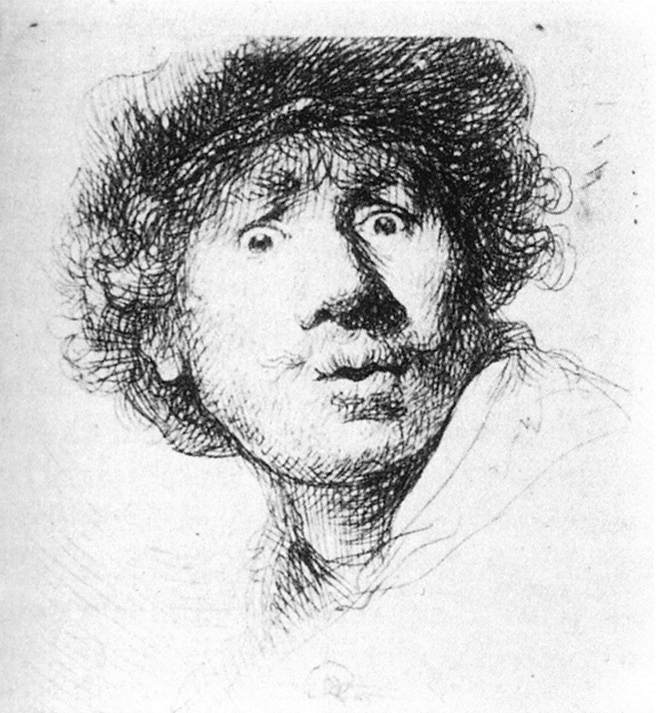
Rembrandt, Self-Portrait in a Cap, Open-Mouthed, 1630, etching


Art was one of those classes I took to offset my load of “real” course work. The teacher was straight out of the textbook.  Perhaps my memory is tainted, but he really did look like Van Gogh, minus the bandaged ear.  He was a quirky, melancholy, disheveled man who became highly animated when he talked about artwork.  I don’t remember much from class other than sketching leaves, a tennis shoe, and shadowed 3-dimensional blocks.  The most lasting instruction I received from Van Gogh was:  “Don’t ever say that a painting is pretty.”  The humble beginnings of my art appreciation education.

One of the perks of our homeschooling lifestyle is the freedom, flexibility, and capacity to step out of the mainstream pace of life and delve deeply into whatever we’re studying.  We’ve begun a (one-sided) relationship with Rembrandt Van Rijn.  As with any relationship, we’re in the early stages of turning over various pieces of the puzzle of his life and artwork, and studying them individually.  Each gives a glimpse of the larger, finished project.  As a side note, I’m struck that even if we had lived down the street from him, shared dinners and holidays, and had the ability to talk with him over a hot cup of Dutch koffie, we’d still limited in how well we could know him.  That’s just the way we’re created – as a bottomless box of puzzle pieces.  No matter how many are plucked out, studied, and meticulously rearranged, only the Creator has the vision to see us in our entirety.  I find it somewhat humorous that we think we have each other “figured out.”

But back to Rembrandt… One of the puzzle pieces we’ve pulled out of the box is his uncanny use of light and shadow.  Another is his tendency to buck the convention of the time when painting groups of people.  Rather than paint a series of portraits all on the same canvas, he created a storyline of characters.  His paintings evoke emotion and questions:  “What were they talking about?”  “Who was the man in the shadows?”  “What was she feeling?”  The famous Night Watch was one of those controversial paintings in which Rembrandt created a compelling scene rather than a string of flat portraits.  Not all of his subjects were pleased. Some actually demanded their money back.

Personally, one of the most compelling pieces of the Rembrandt puzzle has been his remarkable insight into human emotion.  His paintings draw you to the souls of the subject.  This unique characteristic of his artwork leaves us with an obvious question:  How did he know so much about the nature of people?

In the 50 years of Rembrandt’s career, he produced more than 90 self-portraits.  He became a student of himself  - not only studying the detail of his physical being, but also exploring the complexities and diversity of human emotion. His discovery of self was not rooted in self-absorption.  Artists who were narcissistic tended to paint themselves repeatedly in their best form.  Rembrandt, however, exposed his heart as both kind and enraged, his mind as both theatrical and analytical, and his disposition as both carefree and pensive.  He used self-study as a tool to gain insight into the full range of the human condition.  And the result was his remarkable ability to capture an extensive range emotional and psychological aspects on canvas.  He deliberately explored and discovered self for the purpose of gaining in-depth insight into others.

So what lesson can we learn from the master?

We live in a society that has written reams of self-help books, booming syndication of Dr. Phil and Oprah, and promises fulfillment if only you can identify and achieve  whatever it is that makes you happy.  Self-examination and self-help are in vogue.  However, I’d argue that the motivation and methodology behind most of today's approaches to self-exploration differ greatly from Rembrandt’s.  And from the Master’s as well.

How can you say to your brother, “Let me take the speck out of your eye,” when all the time there is a plank in your own eye?  You hypocrite, first take the plank out of your own eye, and then you will see clearly to remove the speck from your brother’s eye. Matthew 7:4-5

Having an accurate self-assessment is one of the first steps to loving others well.  We all have some form of plank that blocks our view.  The plank can take the form of arrogance or shame. It can masquerade as intellect, discernment, religion, or volunteer service.  It’s anything that distorts the Truth of who we are,  and it in turn distorts our view of others.  If we’re willing to acknowledge the plank, then to have it removed bit by bit, the process is painful yet the result is freeing.  I’ve shared a bit of my own journey here, and I hope to continue undergoing the process of log-extraction as long as I have breath. Although there will always be remnants of the log this side of heaven, our eyesight can be greatly restored.  As we begin to see more clearly, we are enabled to love others in a way that more closely resembles the love of the Father.  In short, we can begin to get ourselves out the way, and let Him love others through us.  


An unsolicited, unpaid-for, no kick-back, but straight-from-the-heart advertisement:  


For those of you who live in Charlotte and would like to spend some focused energy on the art of walking through life with others, I’d highly recommend your consideration of Barnabas Training.   This powerful approach utilizes reading, writing, group and individual discussions to help us discover "the log in our own eye" so that we are better equipped to see more clearly and love others well.

Tuesday, August 23, 2011

The Other Side of the Stone


Recently, my husband and I snuck away for a weekend in the mountains.  Given life with 5 children who happen to be at such different stages (ages 7-24), our times away are precious and rare.  Through the years, we’ve learned that it’s a good idea to talk about expectations for our time away prior to departure.  Often, we try to run together in the mornings (ahem… that is, he’s gracious enough to jog at a much slower pace than he normally would, and I try to “gut it out” in the spirit of recreating together).   This trip, following a particularly busy season for our family, I opted out.  I wanted time alone to decompress.  He would run alone, and I’d take peaceful morning walks through the tranquil little town of Blowing Rock.

On our second morning away, I felt particularly refreshed from a good night’s sleep. Before I knew it, my morning walk picked up pace, and I found myself enjoying a slow, steady jog. The roads were desolate, the storefronts dark, and I wound my way down the main street, through the park, and eventually back toward the inn where we were staying. 

Having been recently thinking and writing about stones, I was acutely aware of their various uses in the architecture around me.  They piled together creating a picturesque church, lined the sidewalks directing shoppers to their destinations, and paved the way to historic inns.  Yes, the stones represented strength, consistency through years, support and directionThese were good things.

Until…  I tripped.  Yes, as I was swept up in the imagery of the stones, the context abruptly shifted.  I had come to a place on the path where the larger stones had remained intact, but the areas around the stone had been worn away through seasons of use and erosion.  The tip of my shoe caught the edge, and I stumbled to keep from falling.  Hmmm.  Perhaps there is another dimension to the metaphor.

As we pick up in the story of Joshua (you can catch up here), Joshua lists all that God has done to protect and bless the Israelites.  Joshua then charges them to put away false gods (ie idols) and serve God only (Joshua 24:14-15).  Ok – that’s difficult to translate into today's terms.   Although the concept of idols may seem irrelevant in our modern society, unfortunately, they are all too present in each of our worlds.

“We think that idols (counterfeit gods) are bad things, but that is almost never the case.  The greater the good, the more likely we are to expect that we can satisfy our deepest needs and hopes.  Anything can serve as a counterfeit god.  Especially the very best things in life.”  Tim Keller

The people respond to Joshua, “We will serve the Lord our God and we will obey His voice.” (Joshua 24:24)  Of course.  After all that they’d been through, they would be foolish not to.

Joshua takes a large stone to set up under a tree by the sanctuary of the Lord.  We’d expect him to say, “Great!  You’ve made a wise choice that will please your God and serve you well.  Here’s another memorial stone to remind you.”  Instead, his response is ”Behold, this stone shall be a witness against us, for it has heard all the words of the Lord which He spoke to us, thus it shall be a witness against you, so that you do not deny your God.” (Joshua 24:25-28)

Yikes.  The stone was not a reminder of their wise choice, rather it foreshadowed their fickle nature and inevitable return to false gods.  They, like us, overestimated their loyalty to the only One who could ultimately provide for them.

Think of the times you've been provided for.   Chances are, if they’re biggies, the provision came from beyond you.  Only God can bring us through the hardest of situations.  It is when we reach the end of our proverbial ropes that He will step in to rescue.  Yet we spend much of our energies trying to avoid that very thing.  We’re competent.  We’re resilient.  We construct our lives in ways that take control. We work hard to avoid dependence on God in the everyday – I can manage my life, thank you very much.  God can stick to the miracles and healings when I get in a pinch. And that posture of the heart, at its very core, is the  essence of idolatry.


What are some of the counterfeit gods in my life?  Financial security, a unique community of rich friendships, health and well-being of my family, excellent education for my children, intellectual pursuit, and even a healthy lifestyle.  These are good things, but things in which I ultimately place too much hope and significance.


As the memorial stones in life remind us of God’s provision, they should simultaneously serve as a caution to us.  They warn us of our defiant nature, and remind us of  the places we take control and manipulate life rather than resting in the Father.  We try to gain our footing on the gravelly self-made crevices that exist between the solid, sustainable, eternal stones.  And because He’s good and wants what is best for us, He allows us to stumble.  He’s constantly calling us back to Himself.

So after stumbling on the side street of Blowing Rock, I’m reminded that I’m limited.  And that a richer, more peaceful life can be found if I’ll acknowledge my innate tendency to reject God by relying on my own strategies for life.  And the very, very good news is that I’ll find not shame nor condemnation, but rather hope and ultimate rest, when I consider “the other side of the stone.”


Saturday, August 6, 2011

A Good Book is Like a Lemonade Stand


When we moved to Charlotte in 1994, I accepted a job at a large bank as the manager of the Commercial Training Program.  To you non-bankers, it may sound like a stuffy office job.  It was actually great fun.  Not only did I get to participate in hiring the latest crop of college graduates, but they were placed in my care for 12-18 months of training and development.  My charge was to ensure that by the end of that time, they had received all of the coaching, training, information and experience needed to be able to assess the health of a company, negotiate and sell bank products, and manage the entire banking relationship for a portfolio of companies.

I was fortunate enough to partner with a rather progressive consulting company that developed day-long seminars for specific topics.  The owner of the company was a former therapist, and her unique methodology was born from her experiences in the counseling office.  She understood how people learned.  She knew the difference between short-term understanding and life-long, rooted learning.  One of the most impactful seminars that we utilized was “The Lemonade Stand Game.” 

The goal of “The Lemonade Stand Game” was simple.  At the end of the day, “players” would have received an entire semester’s worth of general accounting principles,  and they would be able to remember and apply those principles in real-life situations.  The set up: an actual grown-up version of a lemonade stand, sign, pitchers and all.  The game started by participants buying sugar, water, ice, etc. needed for the stand.  They were given a small amount of cash, but had to borrow the remainder needed for set-up.  And then of course, the participants sold lemonade.  With the cash they collected, they saved some, paid off a portion of the debt, and used the remainder for additional purchases.  Within hours, The Lemonade Stand Game had taken a safe, familiar concept and had used it to build a framework on which could be hung more difficult, complex concepts.  By the end of the day, the players had effortlessly absorbed far more accounting than many of us had retained from several college courses.

Why?  The Lemonade Stand Game had taken a non-threatening, familiar, and safe concept and had used it to build a common framework.  This framework was etched in the minds of the players (really... who could ever forget playing "lemonade stand" in the middle of corporate America?), and it provided a starting point from which other more complex concepts could be hung.  We were surprised by the vast degree of learning that took place with little to no effort.

Good books work in much the same way. 

How?

~Since we can interact with them at our own pace (and without fear of rejection or judgement), they are safe.  Our defenses come down and we are in a much more "teachable"place. 

~Books utilize common ground.  We bring to them our predispositions and our experiences.  They don’t mind.  They begin their work in us where we are.  We strive to identify with the characters, their situations, their hopes, fears and dreams.  Much like meeting a new friend and scrambling to find commonalities, we automatically look for ways to connect.  It is then that story can have access to impact the deepest parts of our soul.

~The scaffolding of new (or changing) perceptions, ideas, and emotion is often constructed without our awareness.  Days, weeks, and even years after the last page is read, we are surprised every time by the random, yet significant ways a story can continue to have impact.  It changes us forever, by subtly shaping how we view the world, and how we view ourselves.

Well-written story can take many forms.  It is sneaky.  It gets inside my heart and my head without my being immediately aware.  Then the lessons learned pop up unexpectedly for years to come.

Here are a few examples of books that have recently influenced the shaping of my mind and my heart:

Infidel by Ayaan Hirsi Ali (non-fiction)
Infidel is an autobiography of a Somalian woman who eventually fled both her country and her family's religious and cultural beliefs.   I began reading Infidel to glean further understanding of the Islamic culture.  Our family has been involved with a Somalian refugee family for several years.  We've visited with the 8 of them in the living room of their small, 2 bedroom apartment.  We’ve heard the horror stories including their midnight flight (on foot) through the jungle to Kenya.  Our children have grown up as friends.  I wanted to understand their culture in a more meaningful way.  But...  I was not prepared for the substantial, disruptive impact that this Muslim woman's true story would have in my own life.  As I read her observations and criticisms of her own culture, I was challenged to look at my own beliefs with new eyes.   I was stopped to consider how my own upbringing and environment had shaped my perspective of family, loyalty, and religion.  As I’m currently reading through Nomad, her sequel, the healthy disruption continues.

The Trunk by Elizabeth Coatsworth (fiction)
Although this book is hard to find, it’s worth the hunt.  The narrative of The Trunk unfolds through the eyes of a woman who follows her artist-husband to the jungle in order to support his dreams.  It ultimately reveals that the individual lens through which we each see the world greatly colors, and yes distorts, the reality of others’ characters and actions.  I was drawn to the adventurous story and the author's startling insight into relationships.  I was not prepared for the extent to which the jarring twists (and truths) at the end would reflect and reveal troublesome inclinations in my life and view of others. The Trunk left me wondering what it would be like to watch a video of my life, only from God's perfect perspective, not my own.  How would I view others differently?  Myself?  My marriage? Friendships?  

Tales of the Kingdom by David and Karen Mains (children's fiction)
In particular, the story of "Princess Amanda and the Dragon."  A hauntingly accurate picture of our subtle slide into seduction.  We make small, seemingly insignificant compromises that take root and grow in our hearts until they become too big to tame.  I come back to this story again and again, and it quietly creeps up in my conscience when I take the first steps in hiding and nurturing my own "baby dragons" that eventually outgrow my ability to tame them.  More on that story another day.


So, as we come to the close of the summer, let us not leave behind the magic of chasing fireflies, swimming pools, and lemonade stands.  There are worlds yet to be explored, friends yet to meet, and "things yet to be thunk"...  all to be found in the pages of a good book.


Sunday, July 17, 2011

Lest We Forget

For years, we've created and methodically stored boxes of pictures, have taken great care in preserving papers and programs of our children's accomplishments, and have accrued far too many trophies and ribbons representing participation in the activity of the season.  Why the hours and meticulous care in documenting our lives?  We don't want to forget.

Last year was a year of transition for our family.  Within a year, we had experienced an almost move to Nashville followed by a real-life move within Charlotte, my husband's transition into a new job after his year at home, and the upcoming marriage of our daughter (just to name a few).  We had spent the prior year assuring our children that God knew what was best for our family, and our job was to believe and follow.  The old hymn "Trust and Obey" became the mantra in the heart of our home.

I love it when whatever we're learning through study collides with what whatever we're experiencing in life.  I imagine that if we slowed down the pace of life, created margin in our days, filled our minds with truth, and waited expectantly, we would experience such a phenomenon with much more frequency.  We were studying the life of Joshua with a local Bible Study (this is the part where I put in a plug for Community Bible Study in Charlotte). The story had reached a pivotal point.  The children of Israel had spent the last 40 years wandering in the wilderness due to their own disobedience.  Finally, the time came for them to cross the Jordan River.  The Lord caused the waters to separate in order for them to cross over and enter the land of their inheritance.  After all they had experienced - the hardship, the disappointment, the heartache, and the longing, the moment had come. It would be a day that they would never forget.  God's forgiveness.  God's provision.  God's faithfulness.  God's abundance.  Or would they...

The perfect Father knew the fickle nature of his children.  So He commanded them to gather stones from the center of the river to set up a memorial to remind them, and their children, of His faithfulness.  I love the picture of...


~God's desire to give us good gifts

     ~Our foolish choices that get in the way

          ~His provision in spite of our unworthiness

               ~Our fickle appetites and short memories

~And ultimately, His wise, kind heart that wants us to remember - for our own good and for His glory.

We've talked a great deal about God's provision for our family in the past few years.  We've gathered at meal and bedtimes to ask for guidance and peace. The loss of (and acquisition of) David's job, the sale of our house, and our move to a new one have all prompted discussions with others about His faithfulness in the midst of an uncertain chapter in our family's story.  For many months, it remained front and center in our thoughts and conversations.  But just like the Israelites, we have short memories.  What seems unthinkable to forget today can all too easily become a faint memory tomorrow.

So, just like the Israelites, we decided to memorialize this amazing season in our family's history.  I don't want to forget.  I don't want my children to forget.  I want them to tell their children.  Of God's faithfulness.  Of His provision.  Of His abundance.  Regardless of circumstance.

One of my favorite features of our new home is the peaceful koi pond tucked away in our backyard.  It seemed fitting that our stones, which will mark for generations God's goodness, come from that pond.

My favorite nook in our new home.


 The children selected their stones, we discussed the purpose, and they commenced their artwork.

Sam's stone - "Because I'm happy"


Will's stone - Our new house.
 The back - "God helped my Dad get a job
 and helped us find a good house
 to live in.  We have been very blessed."  

Caroline's stone - Joseph, Mary, and the baby Jesus.
At first, I thought that she didn't understand what we were trying to do.
 And then I realized that she may have understood better than any of us.

We never made it to math that day.  Or spelling.  Or handwriting. But the lessons that we learned have been deeply engraved  upon our hearts.

***************************

Tuesday, July 12, 2011

The Invisible Thread to Nashville... and Back

If you haven't read The Princess and the Goblin and missed the earlier post giving a bit of background information, you can catch up here.

Back to The Princess and the Goblin… As the story continues, Irene’s grandmother (who lives in the attic and is invisible to everyone but Irene) spins an invisible thread.  She attaches the thread to a ring, then instructs Irene that if she ever finds herself in danger, she is to follow the thread wherever it takes her.   The story proceeds to unfold as Irene is frightened once again by the creatures. Yet this time, she follows her grandmother’s thread rather than reacting out of fear.  Instead of leading Irene upstairs to the safety of her grandmother, the thread leads her outside, down the mountain, through the dark forest and into a dangerous cave.  Although the thread takes her through places of great peril, she ultimately discovers and saves her friend Curdie, who had been taken captive by the goblins and hidden deeply away in a cave.  The thread miraculously leads them through seemingly insurmountable dangers, then ultimately back to the safety of the castle.


*************************

“We’re moving to Nashville.”  Although we knew it had been a possibility and had seen friends who were in the same position, we never thought that we’d be the ones preparing to leave.  Two years ago, my husband’s group at the bank was disbanded.  It was the day before our anniversary when he received the news.  In his words, “While most wives were understandably worried about what was coming next, mine was giddy.” Only weeks earlier during our weekly small group meeting, I had casually uttered, “I wish it would all stop.  That the hamster wheel would come to a screeching halt.” After years of over-commitment and unrelenting activity, I longed for a slower pace of life.  Be careful what you ask for…

After absorbing and then processing the news, we decided to take a 6 month break before looking for employment.  By worldly standards, it was a risky thing to do.  David was an unemployed banker in a banking city, which was filled with 2,000 of his best friends in the same situation.  But we knew who held the cards.  We knew for whom we actually worked.  We were given the gift of peace.  Our hope was simple.  We wanted to step back, enjoy our family, and open our hands to receive what had been planned for us. This was an opportunity to live in the kind of dependence for which we were created.   Great peace came from living in the moment regardless of the outcome.  David, who tends to be prone to anxiety, slept soundly.  We loved having him home.  The hamster wheel had stopped, and we were having a happy little hamster party.

Within a few months, two ministry opportunities unexpectedly surfaced and became viable possibilities.  Well-meaning friends would ask, “Do you feel called into ministry?”  Our answer seemed somewhat illusive, but it was true.  We’d answer, “We don’t know if we’ve been called into ministry, but we feel like we’ve done what we were supposed to for today.” Seven months flew by, and it turned out that neither of the two ministry opportunities would be our ultimate destination.  During those months, David had chosen to pour himself and his talents into organizations and people we loved dearly, and that had been a gift unto itself.  But still no job.

Eight months into the adventure, it was time to consider banking opportunities that may exist in Charlotte.  He began the job-hunting process.  With 2,000 of his best friends. Although were not married to a particular home or life-style, we had been holding white-knuckled to our amazing community in Charlotte.  We couldn’t fathom leaving.  “God, we’ll do anything… but that. “  Of course, it’s the “anything but that” which he uses to teach us that all we really need is him.  And it’s the “anything but that” which proves that idols don’t have to come in the shape of houses, country clubs, or lifestyles.  They can also come in the form of Godly people and unique community.  

Shortly after commencing the job search,  David received “the call” from a bank in Nashville.  We had always said that we would grow old here, but if we ever had to move, Nashville would be our top city of choice. I started doing homework on churches, ballet studios, and music programs.  We made the house-hunting trip, and I found a beautiful old bookshop in which to make my dwelling while David had his final round of interviews downtown.  The kind old shopkeeper asked if I’d like to go behind the shop to the warehouse, and I spent over an hour digging through stacks of dusty, ragged books.  This could be my new home.  The great finds in the bookstore helped.  I do have my priorities, you know.

We returned to North Carolina and put our house on the market.  Homes in our neighborhood had been lingering on the market for months, and we didn’t want to waist time.  We had talked for years about moving to another neighborhood, so there seemed to be no downside and we had plenty of time to sort out the details.  Or so we thought.  Our home went under contract in less than 12 hours and after 3 showings.  We were shocked.  We were moving. 

Later that week, David received an unexpected call from a former colleague.  We were surprised to learn that he was a final candidate for a job in Charlotte. The folks in Nashville graciously allowed him the time to decide, and the folks in Charlotte sped the process up beyond what we could have anticipated. You can guess the end of the story.  We’re still here.

Although we all know that life can turn “on a dime” and that we ultimately have little control of our own destinies, we spend an extraordinary amount of time and energy fighting that universal truth.  We think we can plan, maneuver, and even convince God to give us what we want.  We’ve inherited an insidious spiritual cancer that tries to convince us that we know best.  Then God is gracious enough to intervene and remind us that it’s not true.  That he knows what we need far better than we do.  What we need is often not what we want.  What we need most is dependence on Him. 

Today, we stand grateful for the invisible thread which led us through such an adventure.  The path was never clear.   It was full of twists, turns, caverns, and surprises that didn’t make sense at the time. We experienced many great gifts during those months – time together, peace in the midst of turmoil, steadfast friends, and the storybook ending of staying in Charlotte.  Yet we've seen enough life to learn that although these are good things, they too could be taken away at any time. 

The greatest gift that we received along the way has been the assurance that "no, we are definitely not in charge."  And yes, the One who is in charge is good and faithful and true.  He gently leads if only we’ll choose to unwrap our white-knuckled fingers from around whatever it is that we grasp - in order to hold tight to the invisible thread. We can't hold both at once.  May we remember and believe, as Irene’s grandmother promised, “You must not doubt the thread.  Of one thing you may be sure, that while you hold it, I hold it too.


****************************

For the rest of the story, visit "Lest We Forget"


Sunday, July 3, 2011

Two Words

Yep, that's the face.

It is generally understood that most children (and parents) undergo a degree of decompression as they leave the hectic school year behind and enter the realm of those golden months of summer.  Early mornings, busy schedules, and revolving deadlines are traded in for a more relaxed pace of life and significantly more free time.  This is what we’ve all been waiting for.  That is... until our sweet little cherubs, who have anticipated this emancipation for months, utter those 2 dreaded words.  “I’m bored”. 

Lest you think that the shift from school year to summer vacation is any less of an adjustment for those of us who have school in our homes during the year, take heart.  You are not alone.  Our children know the drill.  We typically don’t watch TV during the week, and they are in the habit of spending their abundant free time reading, creating, playing music, getting muddy in the creek,  and designing and implementing battle plans upon each other and their friends.  But something magical (hmmm) has happened in the last weeks.  As our outside commitments and internal schooling expectations have come to a creeping pace, there has been a shift.  My children, who have the skills, raw materials, and experience in creating their own adventures, seem to have regressed. 

 A few mornings ago, as I was basking in the luxury of enjoying a cup of coffee and time alone on our porch,  I became somewhat sentimental.  Having married a man with 2 young children, then adding 3 more to the crowd, I have had little people in my life for the past 18 years.  Our entire married life has been one of parenting.  For the first time, we don’t have babies.  We don’t have teenagers.  Our big kids are growing into delightful adults and my youngest is 7.  Old enough to sleep beyond 6:30 in the morning.  Finally.  I don’t have to rise before dawn to have time alone.  We’re in a sweet window of family life.  The summer has come.  Relief from schedule.  Fun outings planned and great books to be read as a family in the weeks to come.  As I was reflecting on how grateful I am for such a delight-filled season, Sam, my big-blue-eyed 9 year old, entered the scene.  It was 9am.  He proclaimed “I’m bored.”

As fate (or more likely Providence) would have it, my 20 minutes of contemplative reading for the day was surprisingly relevant.  In Buechner’s “Listening to Your Life", he observes, “You can be bored by virtually anything if you put your mind to it, or choose not to.  You can yawn your way through Don Giovanni or a trip to the Grand Canyon or an afternoon with your dearest friend or a sunset.  There are doubtless those who nodded off at the coronation of Napoleon or the trial of Joan of Arc or when Shakespeare appeared at the Globe in Hamlet or Lincoln delivered himself of a few remarks at Gettysburg.  The odds are that the Sermon on the Mount had more than a few of the congregation twitchy and glassy-eyedTo be bored is to turn down cold whatever life happens to be offering you at the moment.”

Isn’t that the truth?  As adults, we often live our lives in much the same way.  We’re bored.  Only we’re too sophisticated to use the word.  So we submit to the mindset without even knowing it.  We spend our days longing for (or regretting) our past.  Or we live in a state of waiting for (or fearing) the future.  We too miss the beauty that each moment of the day has to offer. 

“Bored” provides it’s own sense of security.  It doesn’t require of me.  It’s familiar.  It’s easy.  I trade in my books (or art, or music) for the TV.  I give concentrated chunks of time to returning email (or whatever else we find to do on the computer), yet rarely build that kind of time in my day to play with my children or talk with my husband.  I can keep my schedule so full of good things that I miss the best things.

So maybe, just maybe, our children become bored because they’ve (gasp) learned it from us.  Our busy schedules and addictions to our Blackberrys and iphones provide a constant stream of stimulation from the outside world.  Rather than experiencing the full range of vibrancy that life has to offer, we settle for the counterfeit and live life being entertained.  This can come in the form of a video game for my children… or in the the form of a favorite nightly TV show.  Neither is implicitly a bad thing.  That is, unless it soaks  up  my time and energy which prevents me from growing, creating, and exploring.  From becoming all that I was created to be.

As I hope to encourage my children to be grateful for and bask in what each day, even each moment, has to offer, I hope to do so myself.  I want to live life wide-eyed enough to view my everyday with a sense of anticipation.  Yet to do so requires discipline to be still.  The courage to hope for more.  And the willingness to be proactive in pursuing that which brings me great joy.

So as you launch into the heart of the summer, my hope for you is the same.  That you find time to be still.  That you discover (or remember) whatever it is that brings you joy.  That you wake up in the morning with the wonder of a child. Read a great book.  Take a class.  Try something new.  Notice the miracles that occur in your everyday.

Happy summer to you and yours!

Tuesday, June 28, 2011

Of Brick and Straw


~This entry was written two years ago on our 15th wedding anniversary.  

You know the story… the three pigs, the three houses, and 2 very different outcomes.  What made the difference?  The materials with which the houses were built.  On the 2 ends of the spectrum are the straw and the brick.  I want a life built out of brick… but never would have thought that the straw would be part of the process.

As a child, like so many others, I grew up in a semi-functioning family.  The stress fractures that had been present throughout my parents’ marriage became too great when a poor economy resulted in a job loss.  This proverbial straw that broke the camel’s back resulted in the ultimate demise of my parents’ marriage and of family life as I knew it.

This week, we received what could have been devastating news.  After 17 years of faithful and productive service, my husband’s lucrative job was to come to an end.  We had had some inclination that as the result of another bank merger, this could be an outcome.  Yet we had little idea what and when the ultimate decision would be made.  Here we are.  With 5 children and little savings left due to the economy, we are more than ok.  We’re grateful.  For life, for family, for health, for a challenging marriage that has withstood the storms (both internally and externally) of 15 years, for friends who have walked through those storms with us, but most of all, for our loving God who wants what is best for us and is relentless in providing it.  In His upside-down economy, what is best is rarely what we would choose, yet it is ultimately what will bring us joy, peace, restoration, and healing.  We are grateful.  This is his best for us. 

“The biblical detail about using straw in brick-making is puzzling to some.  How, they ask, could the addition of straw as an ingredient make bricks stronger?  In Egypt the mud-straw combination was commonly used to strengthen building blocks.   It also prevented the bricks from cracking or losing shape.  Modern investigators have run tests to show that when straw is mixed with mud the resulting bricks are three times as strong as those made without straw.  Fluids in the straw release humic acid and harden the bricks.  To this day, after thousands of years, mud-brick monuments still stand in Egypt. (The Good News)”.

I’m struck that when we allow the Lord to take the straw of our lives… the hurts, heartaches, disappointments, and yes, our blatant sinfulness, he can mix it in with the mud of the world…  job loss, illness, the end of a significant relationship… and use it all to build something stronger.  Yet it is only after that mixture spends significant time in the refiner’s fire that it becomes strong.  Strong enough to withstand the storms of life.  Strong enough to play a part in giving others temporary shelter when their storms come.   

What am I doing with the straw in my life?  Too many years have been spent coddling the hurts, regretting the past, and harboring an unforgiving spirit.  The straw remains not only weak, but highly flammable given the right environment.  My desire is to loosen my grip on the straw and hand it over to the Lord.  Only then is He able to resume His work as the great potter.  Only then will the strengthening and building begin.  I have a choice. 

And so it is.  Life is built, brick by brick.   A series of daily choices.  I pray for the faith, strength, and courage to believe that our Lord wants what is best.  That he will take the broken pieces of my life and create something beautiful for His glory and enjoyment.  That the fires of life will not last longer than needed, but long enough to produce strength.  And that eventually, we will not speak in terms of straw, bricks, and fire, but of roads paved in gold.